
Golden tilefish fishing is deep-drop fishing with a specific address: the outer continental shelf and upper slope, where NOAA Fisheries places a species ranging from Nova Scotia to Suriname. The U.S. fishery is managed from Maine through Virginia, concentrated between Nantucket Island, Massachusetts and Cape May, New Jersey, and more precisely between Hudson and Veatch Canyons. You are dropping bait into burrows in the mud, hundreds of feet down, and reading the drift so you can do it again.
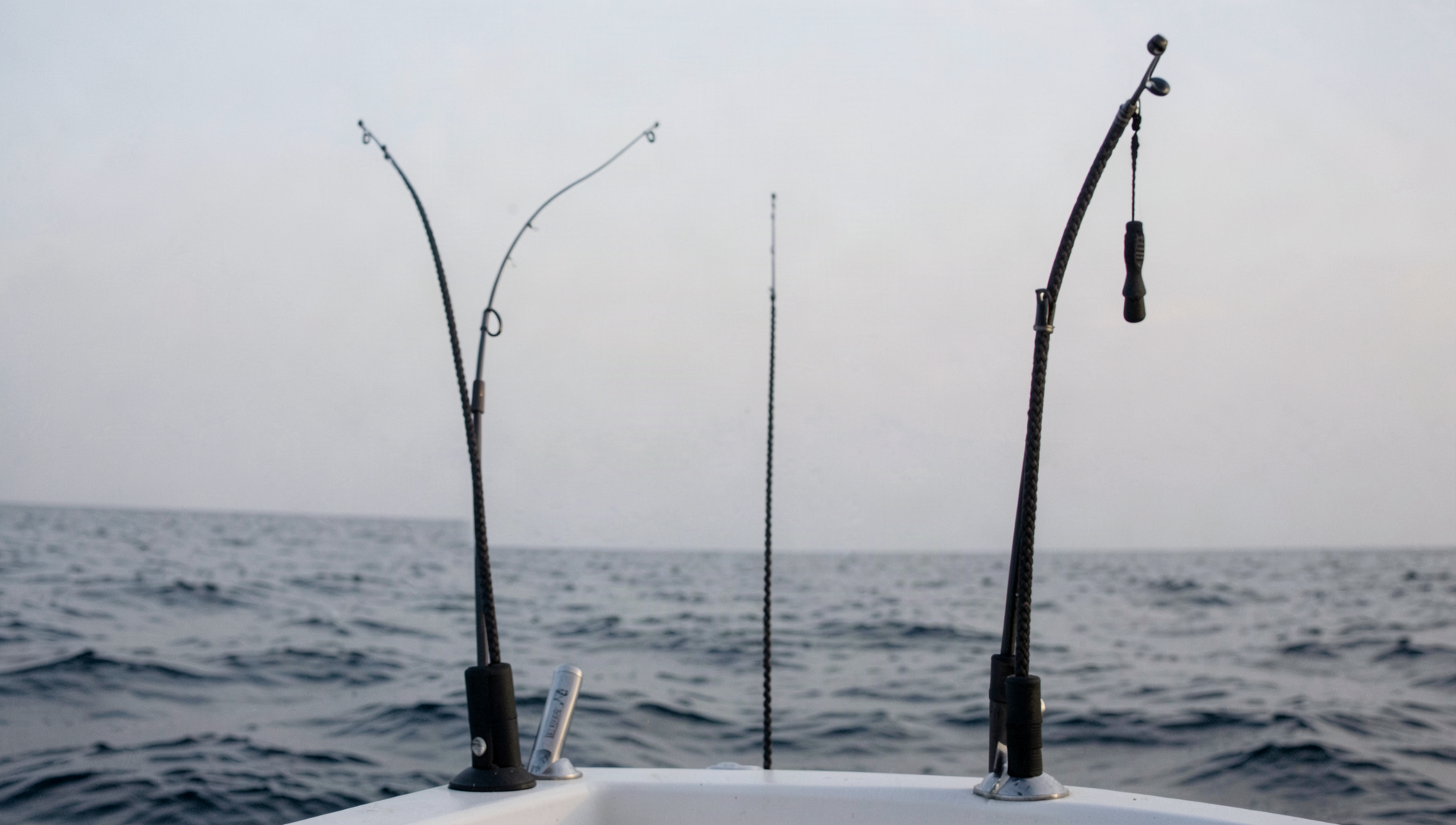
If you want to know how to catch golden tilefish on ground you have never fished, the order of the work matters as much as the tackle. This guide runs the sequence: the rules for your zone, a rig that survives the drop, tackle matched to the depth, ground you can find and mark, and a fish handled properly when it comes up. Manufacturer specifications are attributed by name and model; where a judgment is ours, we say so.
Important
- Only rod and reel gear is allowed in the recreational golden tilefish fishery.
- Private recreational vessels targeting or retaining golden or blueline tilefish from Virginia to Maine need a federal permit and must report the trip.
- The Mid-Atlantic and South Atlantic are managed separately, split at the North Carolina/Virginia border.
- Bigger hooks do not catch bigger tilefish: a survey of both species found larger hooks did not capture more large fish.
Start with the fish, not the gear
Golden tilefish (Lopholatilus chamaeleonticeps) is the species the name refers to, and blueline tilefish (Caulolatilus microps) is the other regular catch on the same ground. The New Jersey Division of Fish and Wildlife describes bluelines as dull-olive grey, fading to white underneath, with a gold stripe underlined in fluorescent blue from snout to eye and a flat spine on the gill cover, and no fleshy structure behind the head, which is what separates a golden tilefish at a glance.
Where they live on the shelf break
Bluelines hold on the continental shelf and upper slope in water from 59 to 73°F, at depths of 240 to 780 feet, over mud and rubble that lets them dig and occupy burrows they share with grouper and snapper. Our view: anglers and divers know the burrow field as pueblo habitat. Golden tilefish work the same outer shelf and slope band.
That burrow habit explains the fishing: a tilefish is not roaming a reef, it is at an address. Bluelines feed opportunistically on portunid crabs, mollusks, polychaete worms and brittlestars, so the bait that works sits still in front of a burrow on the mud-and-rubble bottom anglers call green mud.
Read the regulations before you rig
Tilefish are federally managed, and the first split to understand is the North Carolina/Virginia border. The Mid-Atlantic Fishery Management Council manages golden and blueline tilefish from Virginia through Maine under the Tilefish Fishery Management Plan; south of the line the South Atlantic Fishery Management Council takes over. Federal fishing regulations are not always the same as state rules, so check both before you plan a trip.
Mid-Atlantic and South Atlantic management zones
The Mid-Atlantic plan was first developed in 2001 for golden tilefish and has run an individual fishing quota program since Amendment 1 was implemented in 2009; blueline tilefish was added by Amendment 6 in 2017. Its management unit covers all U.S. federal waters north of the North Carolina/Virginia border.
Permits, reporting and closures
Any private recreational vessel that intends to fish for blueline or golden tilefish north of that border needs a federal private recreational tilefish vessel permit before taking a trip, applied for through GARFO Fish Online. Operators must then report every trip that targeted or retained tilefish within 24 hours of returning to port, using an approved electronic vessel trip reporting system.
Warning
A closed season closes the boat, not just the water. South Atlantic recreational harvest of golden tilefish closed on August 28, 2018, when landings reached that year's annual catch limit of 2,187 fish, and it applied in state and federal waters alike for vessels with a South Atlantic Snapper-Grouper charter permit.
Build the rig: terminal tackle that survives the drop
A deep drop rig does an unglamorous job: get bait to the bottom, hold it there, and come back loaded. The standard build described on the deep drop rigs and tackle resources page is braided main line for strength and low stretch, several hooks along the leader, weights up to several pounds, and a light near the bait.
Line, leader and the braid-to-leader join
Solid-core braid is the main line. A retailer listing for Diamond Generation 3 8X braid gives 0.28 mm at 30 lb, 0.33 mm at 40 lb and 0.36 mm at 50 lb on the pocket spools, and 0.52 mm at 100 lb on the 300-yard spool. Leader diameter climbs much faster: Momoi Extra Hard nylon leader measures 0.59 mm at 30 lb, 0.65 mm at 40 lb, 0.70 mm at 50 lb and 0.95 mm at 100 lb.
| Rated test | Diamond Gen III 8X braid | Momoi Extra Hard nylon leader |
|---|---|---|
| 30 lb | 0.28 mm | 0.59 mm |
| 40 lb | 0.33 mm | 0.65 mm |
| 50 lb | 0.36 mm | 0.70 mm |
| 100 lb | 0.52 mm | 0.95 mm |
That gap is why the braid-to-leader join is worth practising on the dock rather than at 600 feet.
Hooks and bait
Squid is the bait these rigs are built around. The queen snapper build on the rig variations guide pairs two glow squid on size 8 hooks, while the double-hook paired rig runs 6 to 8 hooks in sizes 7 to 15, assembled in pairs over a 3 to 5 lb sinker and 200 lb mono line with a light attached.
Hook size deserves a caution: a fisheries-independent pilot survey conducted by SUNY Stony Brook found that larger hooks did not capture more large tilefish of either species. Inline circle hooks are the default; Gamakatsu's Octopus Inline Circle in 8/0 is a non-offset, straight-eye hook sold 25 to a pack and listed as tournament legal.
Rig patterns: chicken, curtain and paired hooks
Deep drop rigs mostly differ in where the weight sits and how many baits ride above it. The STC rig puts a heavy circle hook directly on the main line with a leader of five to twelve feet. The Rule rig uses a sliding sinker with an extra leader section and 20/0 octopus circle hooks, dropping to 14/0 heavy-action circles when the bait is a small live anchovy or sardine.
Our view: the names that circulate for multi-bait builds, chicken rig, dropper loop rig, meat curtain, describe the same idea, a spread of baited droppers above a heavy sinker. What matters is the spacing: close enough that the rig fishes as one unit, far enough apart that hooks cannot find each other on the way down.
Match rod, reel and sinker to the depth
Deep drop fishing usually means 300 to 1,000 feet or more, and at that depth the retrieve is a hand-crank problem before anything else. The same resources page names electric reels as the answer to the weight and strain of the retrieve, fish included, and lists the Penn Ally Boat Rod, a graphite composite blank with a solid tip, among deep drop rods.
Sinker weight, current and depth
Sinker weight makes or breaks a drift, and it is a judgment rather than a table. Our approach: start heavy, watch the angle of the line, and step down until the rig just stops drifting, then go back up one step for the next drop. Our view: current at 600 feet is not the surface current, so the weight that held at slack water rarely holds all day.
Rod power and length
Our view: match the rod to the sinker you use most, not the heaviest sinker you might use. Our view: a rod rated for 5 lb of lead fishes like a broom on a slack tide when you are carrying a pound.
Electric reels and power at sea
Power is where a deep drop boat fails first, and it is the part of the setup least likely to be written down anywhere. Our view: an electric reel works hard under load, and a clip-on pack mounted at the rod takes the reel off the boat's wiring entirely. Our view: read the amp-hour rating against the drops you plan, and carry a charged spare; portable electric reel battery packs are listed here.
Lights: green, white and what the specs actually say
Deep drop rigs commonly carry light at the bait, LED or glow stick, and green LED deep drop lights get the most discussion. No specification sheet in front of us states lumens, depth rating or battery life for a deep drop light, so we will not print a green-versus-white comparison as though we had run one. Our view: run light as an experiment on your own boat, same drift, lit and unlit, and count.
Golden tilefish fishing spots and the map you build
Talk about golden tilefish fishing spots tends to orbit the Mid-Atlantic canyon country. Our view: the canyon names that circulate, Hudson, Norfolk, Baltimore, Washington, matter less than the depth band and substrate beneath them, and a canyon that fished well last week can be empty today.
Drift, mark and protect the burrows
Our view: because both species dig and hold burrows, tilefish ground is a spot rather than a zone, and a productive mark can be small and repeatable, which is why it is worth protecting. Our view: plot the mark where the rig first loads, not where the boat started drifting: the rig falls at an angle, and the bottom position is the one that matters.
Build your own golden tilefish fishing map rather than collecting someone else's. Our practice: a numbered waypoint for every mark, a note recording depth, substrate, drift direction and what came up, and one rule: the file lives on the plotter and in a phone.
Work the drop: the sequence
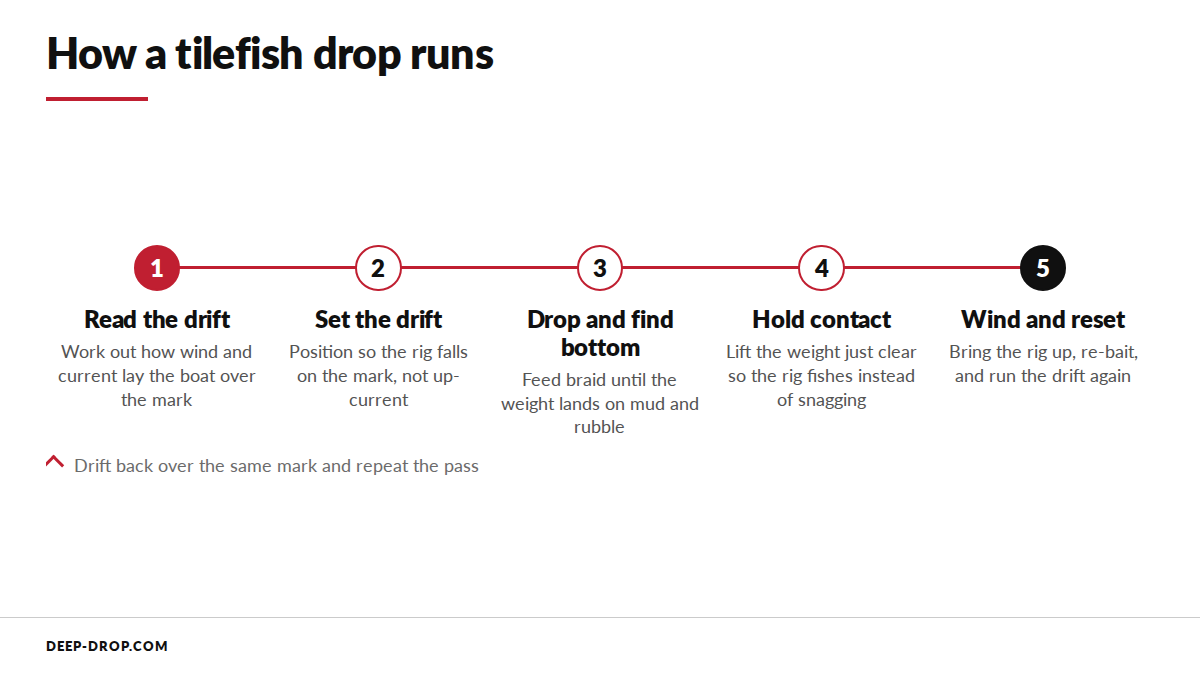
The drop is a loop, and the loop is where trips are won. Work it in this order.
- Read the drift first: wind and current decide how the boat lies over the mark.
- Set up so the rig falls on the mark, not up-current of it.
- Bait, check every hook point, and lower under control.
- Find bottom, then lift the weight just clear of the mud.
- Hold contact and let the rod or reel read the bottom.
- Wind on the first solid weight, ready for a second fish.
The drop, the load and the wind
Our view: the first habit is patience on the way down: at 600 feet the rig takes real time to reach bottom, and guessing costs the drop. The second is reading load. Our view: a tilefish that takes on the fall shows as weight rather than a bite, so wind when the line loads instead of waiting for the rod tip to move.
Landing and releasing a tilefish
Our view: wind steadily, keep the rod loaded, and have the leader and a wet deck ready before the fish reaches the surface.
Barotrauma and descending devices
Send a released fish back down. Our practice in federal waters is to use a descending device rather than letting a fish go at the surface, and to keep only what the trip will eat. Our view: on a rod-and-reel-only fishery, the fish you release well is the fish that keeps the mark alive.
The record and what to keep
Our view: the IGFA all-tackle world record is the number most anglers think of first, and it is worth knowing before you decide what goes in the box. Bluelines typically begin to spawn at four to five years old, at 17 to 18 inches for females and around 23.5 inches for males.
Charters, cooking and the trip after
Golden tilefish fishing charters
Our view: golden tilefish fishing charters are a low-cost way to learn a piece of ground before you buy anything. The rules travel with the boat: the 2018 South Atlantic closure applied in state and federal waters alike for vessels holding a South Atlantic Snapper-Grouper charter permit.
Golden tilefish recipe
Golden tilefish is a food fish; NOAA notes the market is for human consumption and that it is often used in sushi. Our simple version: pat the fillets dry, salt them, and lay them skin-side down in a hot, lightly oiled pan until the edges turn opaque, then turn briefly.
After the saltwater day
Our view: an electric reel and a light are the two pieces of gear most likely to be quietly ruined by a good trip. Our routine is a fresh-water rinse for the reel body, the guides and the light, a dry cloth, and storage out of the sun.
- Rinse the reel body, guides and light in fresh water, then dry them.
- Back the drag off before the reel goes into the bag.
- Charge every battery pack to full and store it cool and dry.
- Write down the drop that worked and the weight that held it.
Sources
Research
- Golden Tilefish
- Golden and Blueline Tilefish
- Fisheries-independent pilot survey for Golden ( …
- NJDEP Division of Fish & Wildlife – Blueline Tilefish: A Profile
- Fishing Regulations
- Recreational Harvest of Golden Tilefish Will Close in …
Manufacturer and retailer specifications
- Diamond – Generation 3 Solid Core 8X Braid (Pocket Spools)
- Diamond G3 8X Solid Core Braid – 300 yd. Spool
- Momoi Hi-Catch Classic Nylon Mono Leader Line
- Gamakatsu Octopus In-Line Circle- Size 8/0- 25 Pack
From Deep-Drop.com
- Deep Drop Fishing Resources – Florida Deep Drop Fishing Custom Rigs & Jigs
- Variations of deep drop fishing rigs – Florida Deep Drop Fishing Custom Rigs & Jigs