
Daytime swordfishing turns the assumption most crews carry to the dock on its head: that broadbills only come under lights, at night, in the dark. They don't. Swordfish feed around the clock, and in daylight they hold deep, commonly between 1,200 and 1,800 feet, along the same Gulf Stream edges that produce after dark. You fish them on the drift, with a weighted bait, an electric reel, and a great deal of line in the water.
This guide covers what the drift looks like, how the terminal tackle goes together, what a trip actually costs, which permits apply, and what to do when something on the rig fails at depth. It is written for anglers who already run offshore and want to add a daylight window rather than replace a working night program.
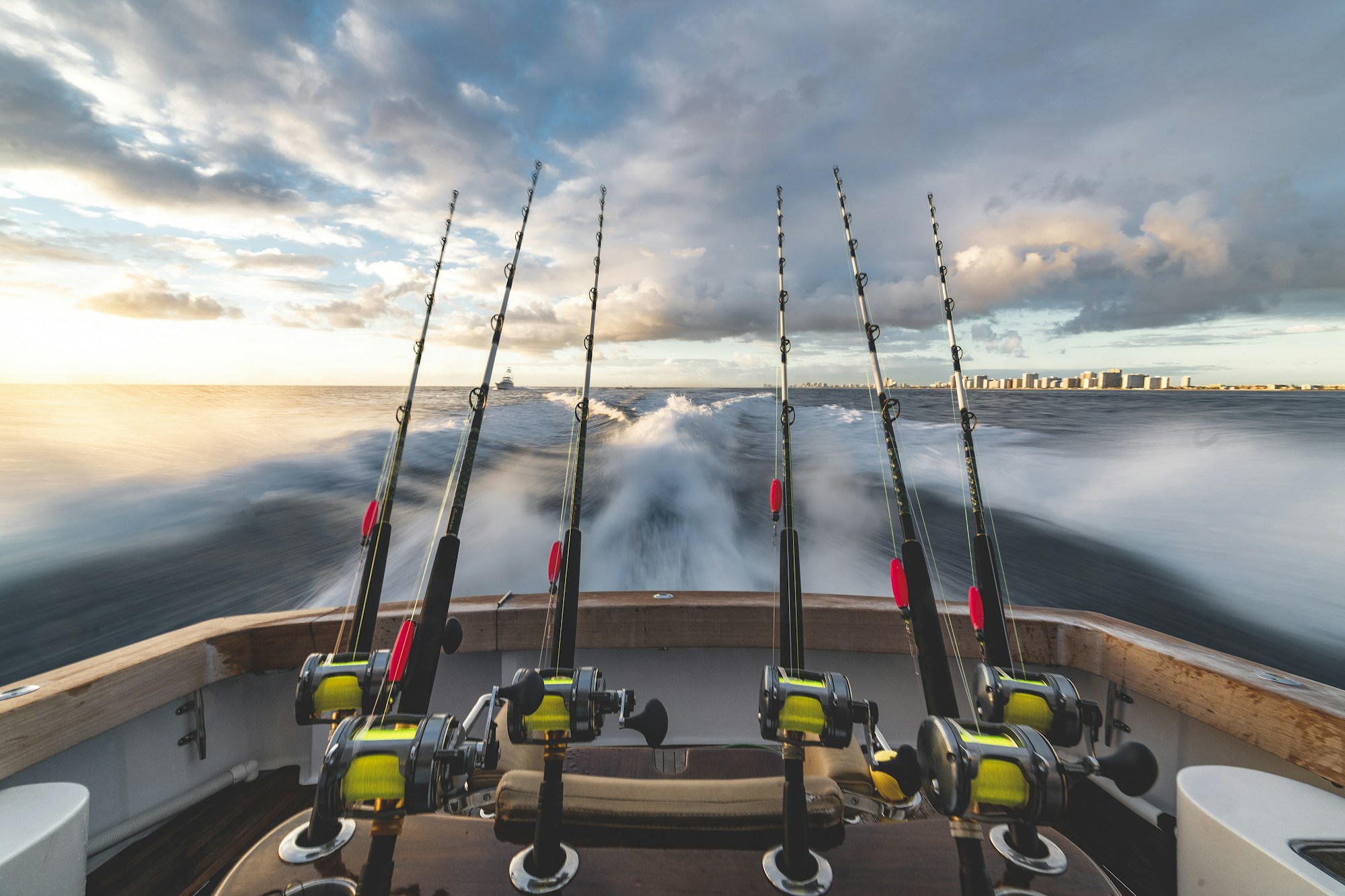
What Daytime Swordfishing Actually Is
Deep dropping in daylight is a drift fishery, not an anchor job. You set up uptide of the contour you mean to fish, send a bait down on a heavy sinker, and let the boat walk across the bottom while the bait swings behind it on long scope. The rod rides in a holder, the reel counts feet, and the angler watches for the line to go slack or start climbing.
Swordfish (Xiphias gladius) are the quarry that makes the effort make sense. The same fish targeted at night over the Straits and the Keys feed during the day on squid, mackerel and whatever else the deep scattering layer pushes within reach. A daytime bite usually announces itself as weight that was not there before, not as a screaming run.
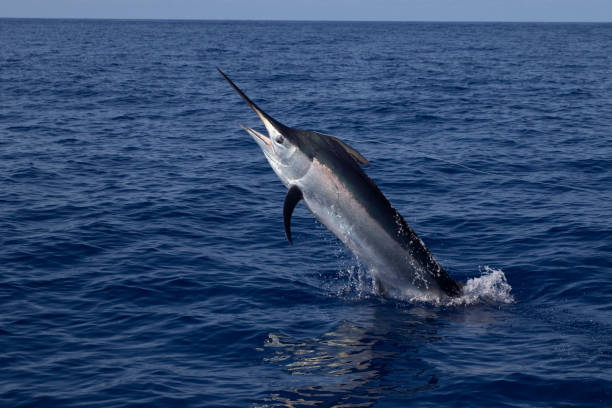
Why the fish sit deep in daylight
The deep scattering layer drives the pattern. It is a dense band of squid, lanternfish and small crustaceans that rises toward the surface after dark and sinks back down at first light. Swordfish follow it. At night they can be caught in the top few hundred feet; at midday they sit at the layer's lower edge, which is why the daytime rig is weighted and the night rig is not.
Where the bites happen
Structure concentrates the drift. The Gulf Stream edge off South Florida — Miami, Fort Lauderdale, Pompano Beach — along with the Florida Keys and the Mid-Atlantic canyon systems such as Washington Canyon, all give the current something to bend around. Seamounts and canyons hold bait, bait holds swordfish, and a drift that crosses a contour change is worth more than one that runs flat.
Crews worth following for the craft include RJ Boyle out of Lighthouse Point, Nick Stanczyk at Bud N' Mary's, and writers like Bill Dobbelaer and Lenny Rudow, who have covered deep-drop terminal tackle in detail.
The Gear That Does the Work
Electric reels and what they change
Hand-cranking from 1,500 feet is a young angler's game and an old angler's regret. Lindgren Pitman electric reels became the default for that reason. When you compare models, including the imported alternatives, the specs that matter are line capacity in braid, retrieve rate under load, usable drag at the spool, and how the reel behaves when the motor stalls. Price tracks those four more than it tracks the badge.
Hooks, leaders and the parts that fail
The Mustad 7691 is the hook most daytime crews come back to: a forged, straight-point pattern that finds the corner of the jaw. Ahead of it runs a wind-on leader, long enough to be handled without a gaff shot at the rod tip. The breakaway sinker hangs below the bait on a light dropper, so the lead releases on the bite instead of dragging a swordfish around by the nose.
Baits and lights
Squid is the workhorse bait, but the belly baits do the heavy lifting. A bonito taco, made by folding a strip of bonito belly onto the hook, holds together through a long soak and bleeds steadily. Add a deep-drop LED strobe or a Duralite Diamond light above the bait. The light draws baitfish, and the swordfish follow the baitfish down.
Rigging a Deep-Drop Setup
Braid is the main line: thin, low-stretch, and it lets a 1,500-foot drop happen in minutes rather than in a slow agony. A short topshot of mono or fluoro takes the abrasion, then the wind-on leader, then the hook. The sinker rides a dropper above the bait on a breakaway band rated light enough to pop on the strike and heavy enough to survive the descent. Get the order wrong and you either lose the lead on the way down or fail to lose it on the bite.
The drop, the drift and the retrieve
The sequence is a loop, not a one-way trip. You set the drift uptide, send the bait down, watch for the change in the line, then wind. Once the fish is aboard or the bait is gone, the boat has walked off the contour, so it is time to run back and set again.
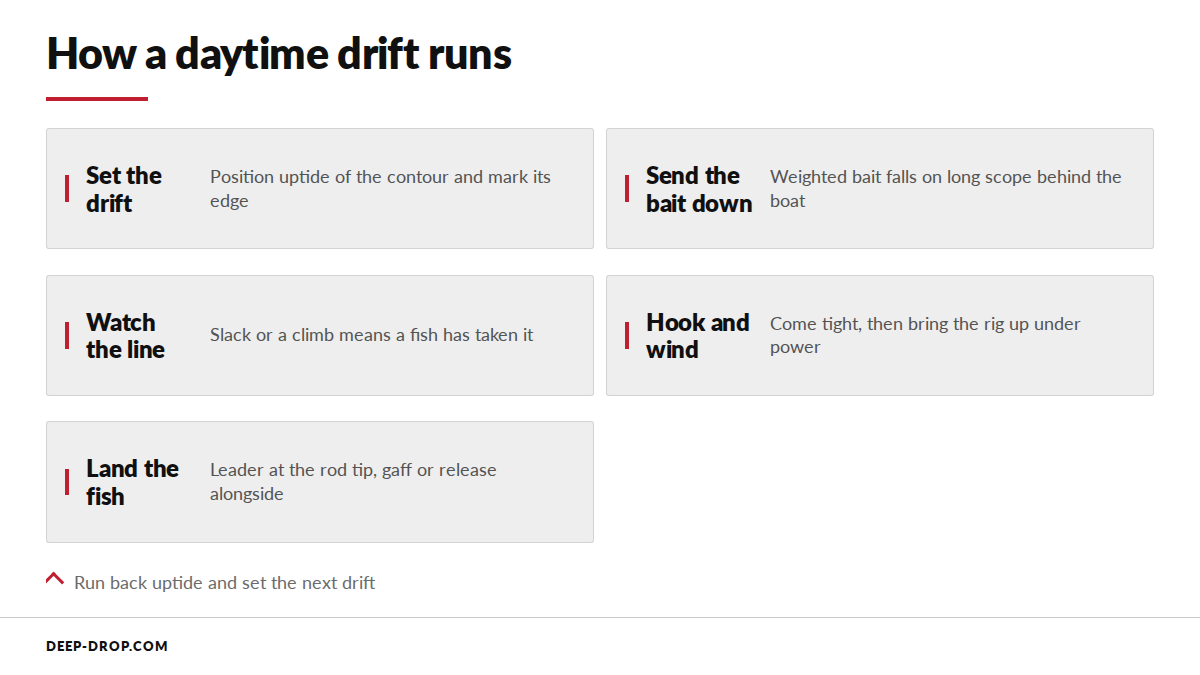
What the Electronics Tell You
A chirp or broadband sounder set to a deep range shows the scattering layer as a fuzzy band that rises and falls with the light. Marks sitting under that band are the ones worth dropping on. Watch the drift speed as well: the boat should move with the current, not against it, and the scope should keep the bait roughly astern. If the line trails at a hard angle, you are drifting faster than the lead you chose can hold bottom contact.
What a Day on the Water Costs
Nobody publishes this, and it is the first thing a new crew asks. A daytime sword trip is not a cheap day, and the cost sits in four places: the charter or your own boat, fuel out and back, terminal tackle consumed, and lead lost on every breakaway. A private boat running to 1,500 feet off South Florida burns real fuel, while a charter splits that across the party.
Building a realistic budget
Plan for these lines:
- Fuel for the run to the edge, the all-day drift-and-reset loop, and the run home
- Ice, bait and chum, including squid by the box and bonito for belly strips
- Consumable terminal tackle: hooks, leader, crimps and breakaway bands
- Lead, at one or more sinkers per drop, the line item almost nobody estimates correctly
- Permit cost spread across the season, plus any charter fee and crew tip
Add those up before you commit a day, and it becomes obvious why a chartered first trip is often the lower-cost way to learn the drift.
Rules, Permits and Reporting
Atlantic swordfish are highly migratory species, so federal rules apply the moment you target them. That is a different rulebook from reef fish, and it is the one most often skimmed on the way out of the inlet.
Permits and size limits
Recreational vessels must hold a valid HMS Angling or HMS Charterboat/Headboat permit, and that permit covers everyone fishing aboard. Minimum sizes and retention statuses are set by NOAA Fisheries and can change with the season, so check the current recreational status page before you leave the dock rather than after.
Reporting after the trip
Reporting requirements have tightened. NOAA Fisheries requires electronic vessel trip reporting in the Greater Atlantic region, and dealers file landing reports weekly, so the paper trail exists and it is not optional. Keep permit, landings and release records together, and log released fish even on days when nothing comes to the dock.
Safety, Sea State and the Right Boat
A daytime drift puts you farther offshore, for longer, in more weather than an inshore trip ever will. The boat needs range, a working autopilot to hold the drift angle, and enough freeboard to take a beam sea while someone is winding a fish from 1,500 feet. A hull that fishes comfortably at twenty miles is not automatically the right boat at fifty.
Choose the day on the forecast, not the calendar. Small-craft advisories, a building sea and a tightening period all argue for staying in. Once a drift is running the crew is effectively committed, because you cannot outrun weather with a bait at depth. Carry a ditch bag, a working VHF and an EPIRB, and decide in advance who winds and who runs the boat.
- Range: fuel to run out, drift all day, and return with a real reserve
- Autopilot, plus a sea anchor or drift sock to hold the boat's angle
- Freeboard and cockpit space to work a fish without kneeling in water
- VHF, EPIRB or PLB, and a ditch bag that lives aboard
Troubleshooting Tangles and Leader Failure
Most daytime failures are predictable, and most are diagnosable from the rig that comes back. A tangle on the drop usually means the bait spun on the way down, so check the dropper length and whether the bait hangs straight. A leader that parts above the hook is usually abrasion from the bill, not a bad knot. A breakaway band that lets go on the drop was too light; one that survives the strike was too heavy.
Diagnosing a break-off
- Clean cut above the hook: abrasion from the bill or the leader drawn across the fish
- Frayed or curled end: a knot or crimp that slipped under load, not a bite-off
- Sinker gone, hook gone, leader intact: the breakaway released on the strike and the fish was never hooked
- Everything gone at the swivel: a connection failure, so re-test every crimp before the next drop
Crimp and knot testing is worth ten minutes at the dock. Pull every crimp to its rated load on a spring scale before it goes in the water, because a crimp that has not been proof-tested is a guess with a fish attached. Re-tie anything with a suspect wrap, and replace leaders on a schedule rather than on failure.
Catch and Release at Depth
A swordfish brought up from 1,500 feet arrives exhausted and often holding expanded gas, because the swim bladder does not cope with a fast ascent. If you do not intend to keep the fish, decide that early. Use heavy enough gear to shorten the fight, lead the fish alongside rather than lifting it aboard, and use a release tool built for billfish.
A harpoon and flying gaff are for fish you intend to keep, and neither belongs anywhere near a release. If the plan is catch-and-release, keep both stowed and keep the leader short so the fish never crosses the covering board.
Daytime or Night: Choosing Your Window
Night fishing is a light fishery fished shallow: you hang lights, bait rises, swordfish follow. Daytime is a depth fishery, where the fish are down with the scattering layer and you go to them. The night bite is generally more consistent in numbers, while the daytime bite tends to produce a better class of fish and a far emptier ocean, because few boats are willing to drift a weighted bait all day. Fish the window your boat and crew are actually set up for.
Read More
For primary sources, NOAA Fisheries publishes the recreational Atlantic swordfish status, minimum sizes and permit rules, and its best-practices video covers handling and release. ICCAT's stock assessments and the cooperative tagging datasets behind them are the origin of most figures quoted second-hand. Beyond the regulators, the written work of Bill Dobbelaer and Lenny Rudow on deep-drop terminal tackle, and the filmed material from crews like RJ Boyle's and Nick Stanczyk's, is the fastest way to see a daytime drift run.