
Learning how to build a deep drop rig comes down to matching four numbers to the water you fish: mainline strength, leader length, drop weight and hook count. Get those four right and a rig fishes clean at 900 feet. Get them wrong and you spend the day cutting tangles out of a leader that spun on the way down, or watching a crimp slip on the haul.
This guide covers the four components, the crimps and knots that hold them, and the geometry that suits tilefish, snowy grouper and queen snapper between 600 and 1,800 feet.
What a Deep Drop Rig Actually Has to Do
A deep drop rig has one job that separates it from everything else in the tackle box: it has to put bait on the bottom in 600 to 1,800 feet, hold it there long enough for a fish to find it, and come back up loaded without twisting into a knot on the way.
Everything in the build serves that. The weight has to beat the current without dragging the leader off the structure. The leader has to survive the haul, which is where most rigs actually fail, not on the bite.
The Core Components
Mainline, Reel and the Weight of the System
Deep drop mainline runs 80 to 130 lb braid. Lighter line cuts the current and gets a lighter sinker down faster; heavier line survives contact with rock. Most crews settle in the middle and let the sinker do the work of holding bottom.
The reel choice is hand-crank or electric. A Daiwa Tanacom, Shimano Beastmaster or Banax Kaigen winds from 900 feet and lets an angler fish a heavier sinker than they could crank by hand all day. A hand-crank reel pushes you toward lighter weights and fewer hooks.
Leader, Swivels and Hooks
Leader is 200 to 400 lb monofilament, and the top of that range is there for abrasion rather than strength. A three-way swivel at the top of a chicken rig anchors the sinker and keeps the leader from twisting against the mainline.
Hooks are circle hooks almost without exception. Mustad circle hooks and Gamakatsu Octopus circle hooks cover most deep drop work, sized to the target and your bag limit. The crimping tool and crimps have to match the mono diameter, or the connection fails quietly, which is why the AFW crimping tool exists.
Target Species
Deep drop covers a lot of ground, and the rig that suits one fish does not always suit the next. Tilefish on mud, grouper on rock and snapper in deep current each ask something different of the leader, the sinker and the hook count.
Golden Tilefish, Blueline Tilefish and Snowy Grouper
Golden tilefish live in mud and sand along the shelf edge, where a stiff rig or a plain chicken rig with a few hooks and enough weight to stay put does the job. Blueline tilefish sit on similar bottom but often shallower, and snowy grouper hold tighter to rock, where abrasion ends the rig.
Queen Snapper and Barrelfish
Queen snapper and barrelfish live deeper, often well past 800 feet, where current and drop time both climb. Rigs for these fish lean on heavier sinkers, more leader length and a Lindgren-Pitman deep drop light to draw fish in.
How to Build a Deep Drop Rig, Step by Step
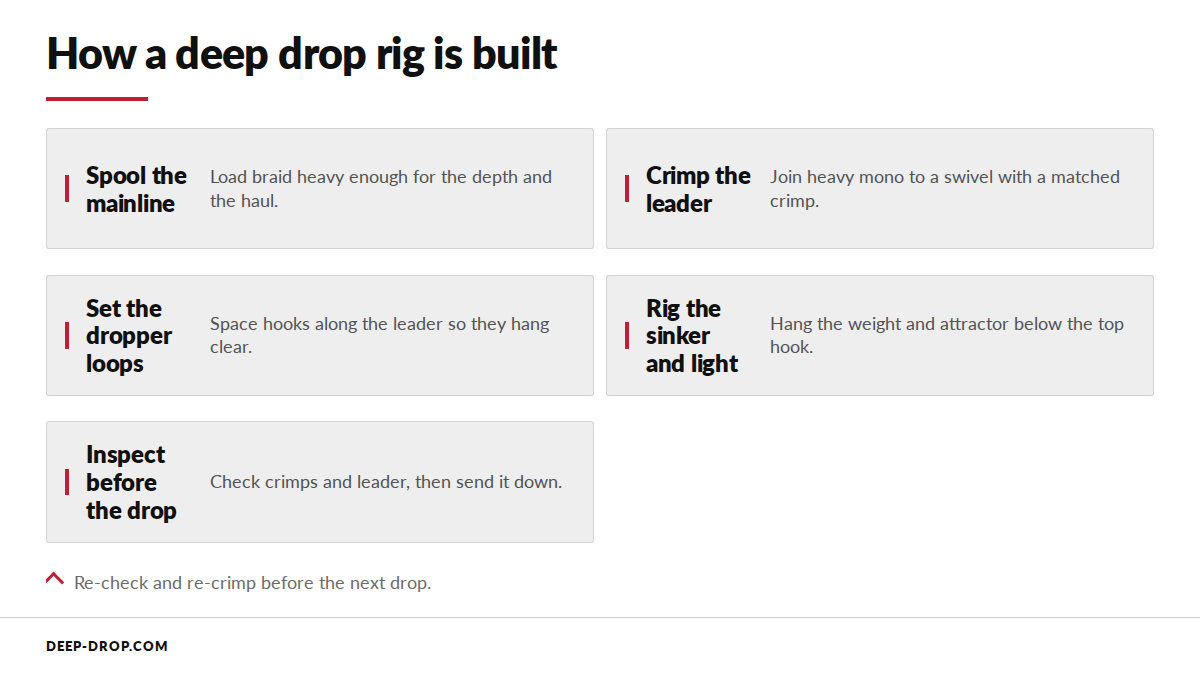
- Spool the mainline. Load 80 to 130 lb braid with capacity for the depth plus the haul.
- Crimp the leader. Use 200 to 400 lb monofilament, usually 6 to 12 feet, crimped to a swivel.
- Set the swivel. A three-way swivel carries the sinker and gives the leader a fixed point to hang from.
- Tie the dropper loops. Space them 18 to 24 inches apart so hooks stand clear of one another.
- Rig the sinker and attractors. Add a sash weight or torpedo sinker, then a Lindgren-Pitman light or glow beads above the top hook.
- Inspect and deploy. Check every crimp and run the leader through your fingers for nicks.
A working chicken rig is simple arithmetic: a leader of 6 to 10 feet of 200 to 300 lb mono, dropper loops every 18 to 24 inches, and three to six circle hooks depending on bag limits and the size of fish you expect. In heavy current, shorten the leader and add weight.
Knot or Crimp: What Holds on Heavy Monofilament
On 200 to 400 lb mono, the question is mostly settled. Stiff heavy mono does not seat a knot evenly, and a badly seated knot is a weak knot. Crimps, matched to the diameter and set with the right tool, are fast, repeatable and slim. Knots still have a place on lighter mono and a few hook connections.
| Criteria | Knot | Crimp |
|---|---|---|
| Strength on heavy mono | Depends on how evenly it seats | Consistent with a matched crimp |
| Tooling | None required | Crimping tool and matched crimps |
| Time per connection | Slower, worse in cold and dark | Fast and repeatable |
| Bulk and profile | Bulkier tag end | Slim, tracks clean |
| Best use | Backup and lighter mono | Swivels, sinkers, loop ends |
Chicken Rigs, Stiff Rigs and High-Low Bottom Rigs
The Chicken Rig (Gangion Rig)
The chicken rig is a main leader with three to six circle hooks hung off it. It is the most versatile of the three, handling tilefish, grouper and snapper on the same drop.
For deep dropping, I use "chicken rigs," a leader with three to six circle hooks depending on the size of fish I am targeting. — Main Attraction Sportfishing
The Stiff Rig
A stiff rig uses heavy, stiff mono so the hooks and traces stand off the leader instead of tangling on the way down. It is the rig for tilefish over mud, where a tangle on the drop wastes the whole set.
The High-Low Bottom Rig
The high-low bottom rig puts one hook above the sinker and one below, covering two levels near the bottom. It suits grouper and snapper holding tight to structure.
Weight and Hook Count: Adjusting for Current and Depth
Sinker weight is a current decision, not a depth decision. Two pounds may hold bottom at 900 feet in slack water; the same depth in a running tide can swallow six or eight pounds without holding. Torpedo sinkers drift less on the way down; sash weights sit tighter once they land.
Hook count follows bag limits and bait. Cut bait stays on the hook through the haul, which is why it carries most deep drop fishing; live bait fishes better for grouper on structure but rarely survives the drop. When current builds, cut hooks before you cut weight.
DIY Rigs vs Pre-Tied Rigs: What You Are Actually Buying
Components make sense for the rigs you fish every trip; pre-tied deep drop fishing rigs make sense as spares, for guests and for the days you lose two rigs before lunch. Deep drop rigs for sale off the rack cover the common configurations, while tying your own lets you tune hook count and leader length to the bottom you fish.
| What you are weighing | Assemble from components | Pre-tied rig |
|---|---|---|
| Upfront cost | Spools, crimps, swivels and hooks in bulk | Paid per rig |
| Time | Assembled at the bench or on the boat | Ready out of the package |
| Consistency | Depends on your crimps and your eyes | Tied to a set specification |
| Repair after damage | Cut out the bad section | Often replaced whole |
| Best for | Anglers who fish often and know their spec | New anglers, backups and guests |
Troubleshooting Tangles and Rig Failures on the Drop
- The rig comes up twisted. Usually a sinker too light for the current. Add weight first.
- A crimp has slipped. Usually a crimp or tool that does not match the mono diameter. Re-crimp and check the rest.
- Hooks tangled with each other. Dropper loops set too close together. Space them out and shorten the leader.
- Leader chafed above the hook. Trim back past the damage before the next drop.
Hand-Crank vs Electric Reel Setups
The reel changes the rig. A hand-crank angler fishes lighter sinkers, fewer hooks and shorter leaders, because every ounce comes up on the arms. Electric reels let you fish heavier sash weights and more hooks, and they make repeated drops past 1,200 feet realistic. The trade is contact: the hand-crank angler feels the bottom.
Maintenance, Inspection and Long-Term Storage
- Rinse leader, crimps and swivels in fresh water after every trip.
- Run the leader through your fingers and retire any section with nicks or flat spots.
- Check crimps for slippage and re-crimp anything that has moved.
- Store rigs coiled, dry and out of sun, with hooks covered.
Release, Regulations and Safety at Depth
Deep drop fishing has rules attached, and the depth makes the paperwork matter. A private recreational tilefish permit is required to fish for or possess tilefish from a private vessel, and reporting follows the permit (Mid-Atlantic Fishery Management Council).
Fish pulled from deep water come up with barotrauma, and a released fish that cannot get back down does not survive. A descending device or venting tool, circle hooks that lip-hook rather than gut-hook, and a quick release all improve the odds (NOAA Fisheries).
Safety is the other half of it. A six-pound sinker swinging on deck at head height is the real hazard, not the fish. Wear gloves, keep the weight under control on the haul, and never wrap line around a hand, on an electric reel especially.