
Trolling lures come in more shapes than any other class of offshore tackle, and the types of trolling lures you carry decide what you can catch at speed. A Kona head, a plunger, a chugger and a bullet each run differently in the water, and each one suits a different fish and a different sea state. This guide covers the head shapes, the natural baits and teasers, the species each one is built for, what they cost, how to rig them, and how to fix the ones that start swimming wrong.
Types of Trolling Lures: How Head Shape Drives Everything
A trolling lure is a head, a skirt and a hook, and the head does most of the work. Its face sets how much water the lure pushes, how deep it tracks, and whether it holds together through a fast pass. Skirted heads are the offshore standard; hard plugs and natural baits fill in the rest of the box.
Kona Head
A Kona head is the classic curved, reverse-tapered offshore lure. It runs straight at moderate speed, sits well in a spread, and survives the strike of a Marlin or a Bluefin or yellowfin tuna (ahi) without coming apart. Run it on 80–130 lb leader with a 9/0–10/0 hook, in the long rigger where it can swim without fouling.
Plunger and Cupped Face
A plunger, or cupped face head, has a flat face with a hollow cup that catches water and throws a heavy smoke trail behind it. It digs in and holds at 6–8 knots, which is what makes it a low-light lure for Bluefin and yellowfin tuna. The cupped face also pushes a bubble trail that pulls fish in from a distance.
Chugger
A chugger has a slanted, scooped face with no cup. It splashes and pops at the surface instead of tracking deep, and it is the shape to reach for when Mahi-mahi (dolphin) are up on a weed line or a floating board. Run it short at 5–7 knots on 50–80 lb leader with a 7/0–8/0 hook.
Doorknob Head
A doorknob head is a short, fat cylinder with a flat or slightly angled face. The wide body runs shallow but throws a big wake, and it holds up under the fast, erratic strikes of Kingfish and Spanish mackerel. Use it near structure on 40–60 lb leader, and expect it to keep running after a hit that would wreck a lighter head.
Slant Face Head
A slant face head is cut at an angle, so the face deflects water sideways and the lure darts and skips. That darting action is what Sailfish and Marlin want in calm, clear water, where a straight-tracking lure looks wrong. It runs best at a steady 6–7 knots on 100–150 lb leader; push the throttle and the head will blow out.
Bullet and Jet Head
A bullet head is a straight cone with almost no face geometry, built for high-speed trolling; a jet head adds holes that spray water through the head as it runs. Both hold their track at 12–15 knots, which is the range where Wahoo (ono) and Kingfish live. Run them on 60–100 lb wire leader with a stinger rig.
Natural Baits, Plugs and Teasers
Not every offshore lure is a skirted head. Natural baits, wooden plugs and hookless teasers all have a place in a spread, and on some days they out-fish everything else in the box. Each one is fished differently and each one earns its space for a reason.
Ballyhoo
Ballyhoo is the bait most offshore crews start with, and it is usually fished behind a skirt or a small chugger-style head. Rigged straight, it swims like a wounded baitfish at 6–8 knots. It is the standard for Sailfish and Mahi-mahi, and one of the few baits that will still draw a strike when the bite has gone quiet.
Cedar Plug
A cedar plug is a simple wooden cylinder with a single hook. It has no skirt and no action of its own beyond a slow roll, and it catches fish anyway — especially tuna and Wahoo — at 8–12 knots. Carry a handful; they are cheap, tough, and they keep catching when other lures have gone cold.
Squidnation and Daisy Chains
A daisy chain is a string of small squid or plastic teasers towed ahead of a hookless lure, and Squidnation builds some of the most widely used ones. A bird teaser does the same job above the surface, skipping and throwing spray. Both pull fish into the spread without offering a hook, so the stinger bait behind them takes the strike.
Matching the Lure to the Species
Marlin and Sailfish
For Marlin and Sailfish, run slant face heads and Kona heads at 6–7 knots on 100–150 lb leader with a 10/0–12/0 hook. Billed fish usually strike a lure to stun it before they eat, so a lure that darts and skips holds their attention longer than one that tracks dead straight. Keep the spread wide and let the long rigger run furthest back.
Tuna
Bluefin and yellowfin tuna (ahi) hit fast and pull hard, and they will eat a lure that is running straight and fast. Cupped plungers and Kona heads at 6–8 knots, on 80–130 lb leader with a 9/0–11/0 hook, are the standard, and a trolled cedar plug will take them too. Mix sizes across the spread to find the class the school is feeding on.
Wahoo, Kingfish and Mahi-Mahi
Wahoo (ono) and Kingfish or Spanish mackerel want speed and wire, and a bullet or jet head at 12–15 knots on 60–100 lb leader with a stinger rig covers both. When Mahi-mahi (dolphin) are the target, slow to 6–8 knots and switch to a chugger or a skirted ballyhoo, and keep a pitch bait rigged and ready.
Conditions, Species and Speed: A Decision Matrix
Most lure choices come down to three things at once: what the sea is doing, what you are hunting, and how fast you want to run. The table below maps the common combinations to a head shape and a leader class.
| Sea state and light | Target | Speed | Head shape | Leader |
|---|---|---|---|---|
| Flat calm, bright, clear water | Marlin, sailfish | 6–7 knots | Slant face | 100–150 lb mono |
| Chop, wind against current | Bluefin and yellowfin tuna | 7–8 knots | Kona head | 80–130 lb mono |
| Open water, long run to the grounds | Wahoo (ono) | 12–15 knots | Bullet or jet | 60–100 lb wire |
| Weed line or floating debris | Mahi-mahi (dolphin) | 6–8 knots | Chugger | 50–80 lb mono |
| Deep water, first light | Bluefin and yellowfin tuna | 5–6 knots | Plunger, cupped face | 80–130 lb mono |
| Reef edge and structure | Kingfish or Spanish mackerel | 4–6 knots | Doorknob | 40–60 lb mono |
| Hot, fast bite on the school | Tuna, Wahoo | 8–12 knots | Cedar plug or bullet | 60–100 lb mono |
Rigging a Trolling Lure Step by Step
The rig matters as much as the head. A perfectly good lure will spin, blow out or pull a hook if the leader, crimp, hook and skirt are not set in the right order. Work through it in this sequence every time.
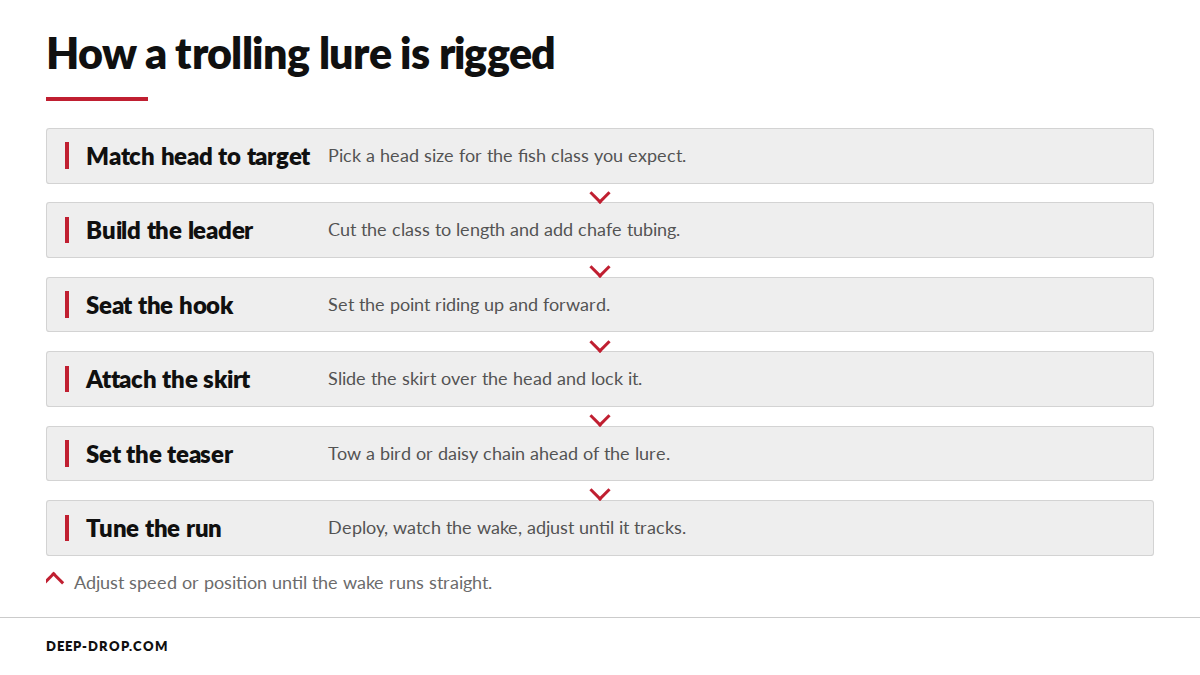
- Match the head to the target. Pick a head size that suits the size class of fish you expect, not the biggest one in the box.
- Build the leader. Cut the class to length and slide chafe tubing over the crimp before you set it.
- Seat the hook. Set the hook so the point rides up and forward, with the eye tucked inside the skirt.
- Attach the skirt. Slide the skirt over the head and lock it so it cannot ride up the leader under load.
- Add the teaser. Tow a bird or a daisy chain ahead of the lure to pull fish into the spread.
- Tune the run. Deploy it, watch the wake, and adjust position or speed until it tracks straight.
Sizing Lures to the Fish
Lure size should track the size class of fish you expect, not the biggest thing in the water. A head that is too large for the school gets bumped and missed; too small, and it draws only the smallest fish in the group. Measure the fish you have been catching, then step the skirt and the head up or down one size at a time until you are getting clean hookups.
Maintenance and Repair
Salt water is hard on resin, skirts and crimps, and a lure that fails at the boat is almost always one that was already damaged. Check the gear after every trip and repair it before the next one.
- Replace chipped or cracked resin faces before the head starts taking on water.
- Re-skirt lures when the skirt tears, stiffens or bleaches out in the sun.
- Swap brass leader tubing and crimps whenever the metal looks scuffed or flattened.
- Check the hook point after every fish and sharpen or replace it as needed.
Troubleshooting Lure Action
Three faults account for most bad-running lures, and each one points at a different fix. Watch the wake for the first half minute after deployment — that is when the problem shows itself.
- Blowout. The head jumps clear and lands sideways — ease off the throttle or move the lure to a shorter position.
- Spinning. The head rolls and twists the leader — check that the skirt is seated straight and the hook sits centred.
- Tumbling at speed. The head cannot hold its track — drop to a heavier head or a steeper face.
Hand-Tuned Heads vs Moulded Heads
Mold Craft, Black Bart and Iland Lures all build skirted heads at production scale, and the better ones run true straight out of the package. A hand-tuned head has its face sanded and its weight set by the builder, usually so it runs true at one speed and one sea state. That is what you are paying for, and on flat water you can see it. In a slop, most crews cannot tell the difference.
Freshwater Trolling Lures
Freshwater trolling runs on a different set of shapes. Deep-diving minnows such as the Rapala X-Rap, spoons and inline spinners are trolled on lead core line or downriggers rather than towed as skirted heads at 8 knots. The logic is identical — match the shape to the speed and the depth you want — but the hardware is measured in inches and ounces, not in head weights and leader classes.
What Each Type Costs
Offshore trolling is one of the cheaper ways into big fish, because so much of the gear is disposable and because a lure that costs a few dollars will still raise a tuna. Prices split into three broad tiers.
- Cedar plugs and bare skirts. The cheapest way in, and the easiest to replace when a fish takes one.
- Mass-produced moulded heads. The mid-range, and where most crews buy in bulk.
- Hand-tuned and custom heads. Sold singly, priced by the work in the face.
As a rough guide, a cedar plug runs single digits, a moulded skirted head sits somewhere between about $15 and $60, and a hand-tuned head starts around $60 and climbs from there.
Where to Get Advice
Customer Service
Head size, leader class and trolling speed are the three choices that cost the most when you get them wrong, and they are the three a tackle shop that actually fishes deep water can answer in a minute. Our customer service team at Deep-Drop.com runs the same rigs and can tell you what head suits the fish you are chasing and what leader to pair with it. Once you know the shape, browse the tackle shop and build the rig.