
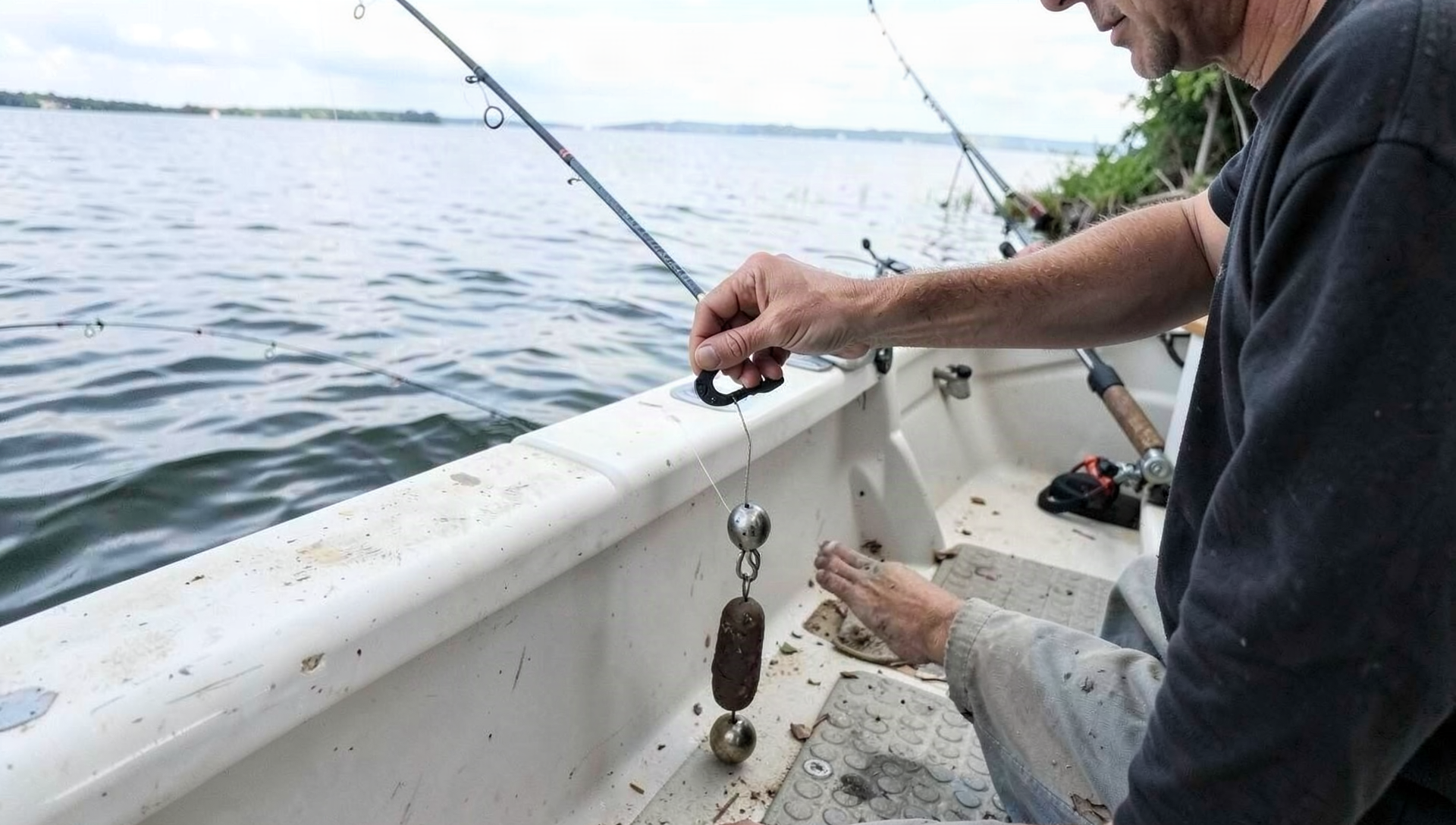
Barotrauma and descending devices are two halves of one problem. Reel a fish up from 50 or 60 feet or deeper and gas expands inside it, displacing organs and leaving it bloated and unable to swim back down (Return 'Em Right). A descending device is the fix: a weighted tool that carries the fish back to depth and releases it where pressure recompresses it. In the Southeast, descending devices are required on all vessels targeting snapper and grouper (NC Sea Grant).
Important
- Barotrauma starts around 50–60 feet.
- Descending recompresses the fish as it goes back down.
- A legal device releases automatically, by the operator, or on its own.
- The rule sets a 16-ounce minimum weight and release at 60 feet or deeper.
Below: what barotrauma does to a fish, what the rules require, how the devices compare, and how to rig and keep one on the tackle you already carry.
What barotrauma does to a deep-caught fish
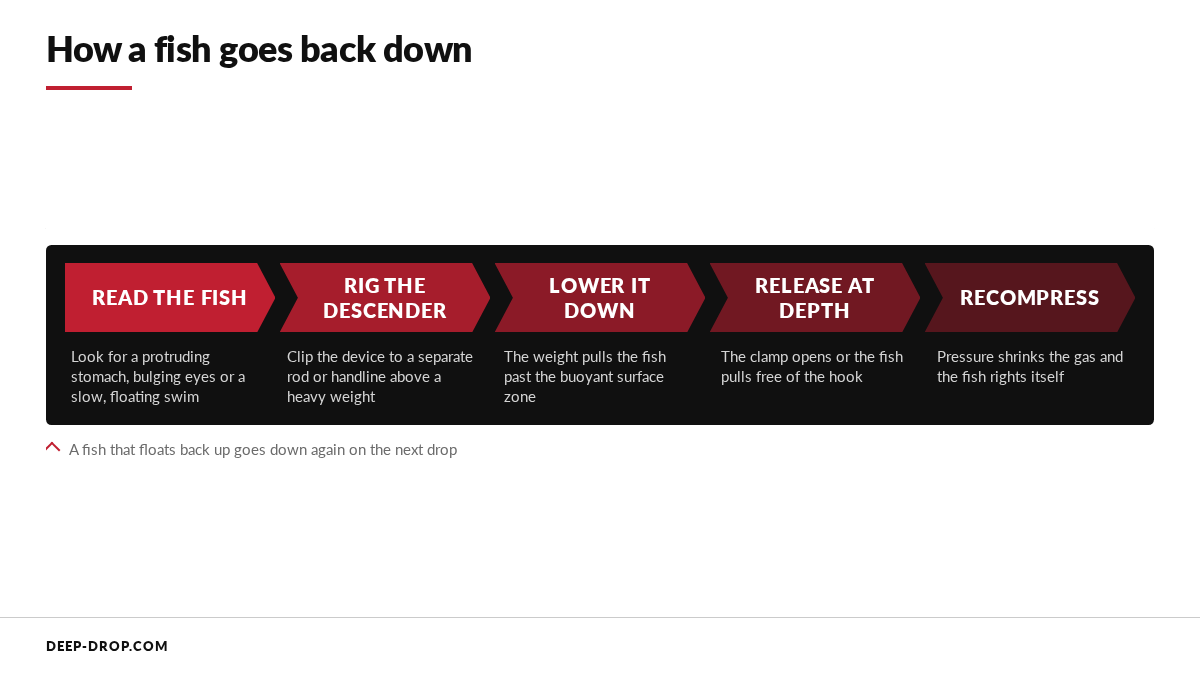
A fish with barotrauma is easy to read at the rail, and the damage comes from the pressure change rather than the hook (NOAA Fisheries):
- Stomach protruding from the mouth
- Bulging eyes
- Bloated midsection or distended intestines
- Sluggish swimming or an inability to swim downward
- Lifted or bubbly scales
Expanded gas makes the fish buoyant, and buoyancy is the problem: many rockfish cannot submerge on their own, so a released fish floats until its injuries or a predator finish it. Descending reverses that as pressure shrinks the gas on the way down (Florida Sea Grant).
The species that carry the worst odds
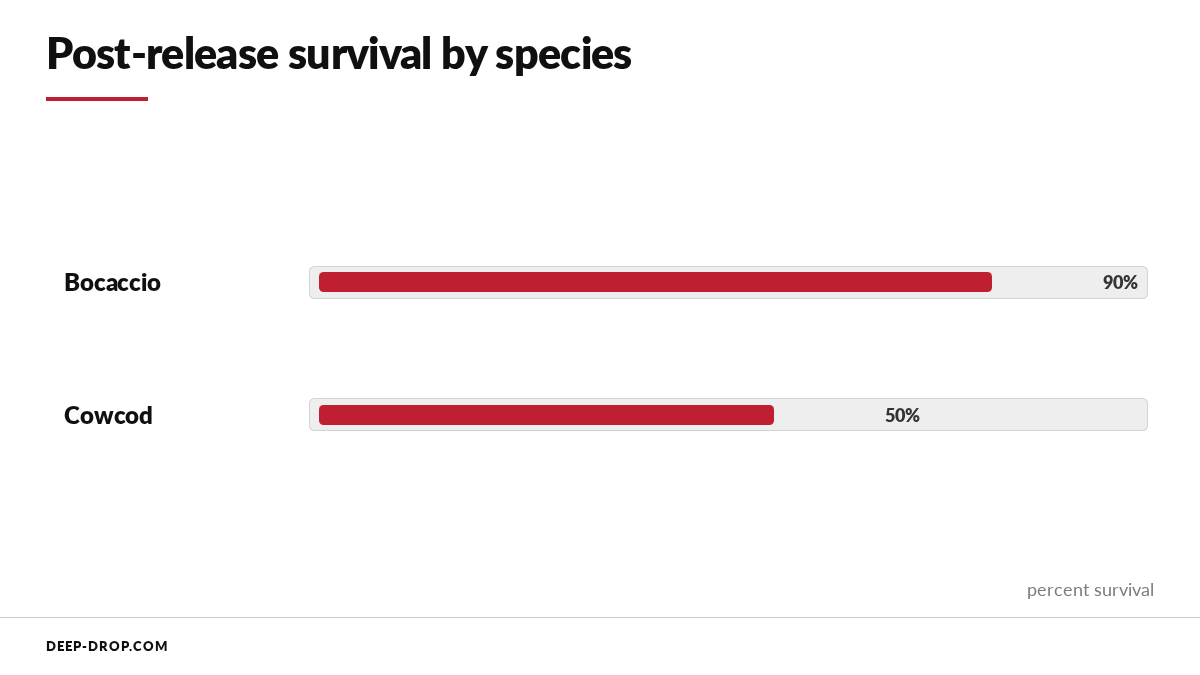
Rockfishes (Sebastes spp.) carry high discard mortality from barotrauma. NOAA's Southwest Fisheries Science Center tagged deep-dwelling rockfish — sunset and bank rockfish among them — with Vemco V9 or V13 acoustic transmitters and lowered them back on a weighted cage or a camera-equipped SeaQualizer. Researchers found bocaccio survive capture and barotrauma approximately 90 percent of the time while cowcod survived about 50 percent of the time, and that surviving fish were affected for about 30 to 60 days.
Depredation: sharks, dolphins and the cost of a floating fish
A fish that floats is a fish you lost. The sources describe sharks and other opportunistic predators taking fish left at the surface, which is the practical argument for keeping surface time short. Our view: on the grounds we fish, bottlenose dolphins take as many floating releases as sharks do.
Barotrauma and descending devices: what the rules require
Congress passed the DESCEND Act to address barotrauma risk, requiring vessels fishing for reef fish in the Gulf to carry a venting tool or descending device rigged and ready for use (Sea Grant Law Center). The Act carried a sunset clause that would have ended the requirement in January 2026, though the Gulf Council voted in November 2025 to continue it — leaning on Return 'Em Right, which has trained more than 47,000 anglers.
What an allowable device has to do
The South Atlantic definition is the most explicit on the books. A descending device carries a minimum 16-ounce weight and a length of line that releases the fish at the depth it was caught, or at a minimum of 60 feet. It must release the fish automatically, by the operator's action, or by letting the fish escape on its own; the rule still permits venting tools for people trained to use them.
Venting tool or descending device
Venting pushes a hollow needle into the body cavity to release the gas. Done properly it works, but it demands knowledge of fish anatomy and precision with the tool, and it can cause further harm when rushed (IGFA). Descending leaves the gas alone and lets depth do the work.
| Question | Venting tool | Descending device |
|---|---|---|
| What happens to the gas | Released through the body wall | Recompressed under pressure |
| Cost | $20–40 with needles | About $100 commercial |
| Skill it demands | Fish anatomy, needle placement | Rigging and lowering |
| Rule's stance | Allowed for trained users | Either tool, rigged and ready |
Warning
Venting punishes a bad angle or a slow hand, and the fish pays for the mistake. If nobody has shown you where the needle goes, carry a descender instead.
Descending devices compared
The commercial market falls into three families — jaw clamps with a release mechanism, inverted hooks, and fish elevators, which are weighted crates or baskets — and each frees the fish differently.
| Device | Family | How it releases | Depth or price |
|---|---|---|---|
| SeaQualizer | Lip clamp, pressure sensor | At a set depth | About $100 |
| Shelton Fish Descender | Inverted hook | Fish pulls free | Greater than 30 feet, $12.99 |
| SeaYaLater | Inverted hook | Fish pulls free | 6,00€ for a pack of eight |
| Roy's Fish Saver | Weighted hook | Fish pulls free | Not stated |
| Inverted milk crate | Fish elevator | Fish swims out | Rope to 50 feet |
The listings carry the numbers: a retail listing gives the Shelton SFD-040 at $12.99, Shelton Products rates descent depth at greater than 30 feet, and SeaYaLater hooks sell for 6,00€ for a pack of eight. No source here publishes head-to-head release-depth accuracy, so the honest benchmark is NOAA's field work on commercial passenger vessels, which found all the devices largely effective at releasing rockfish back toward their depth of capture (Bellquist et al. 2019).
Rigging a descender for deep water
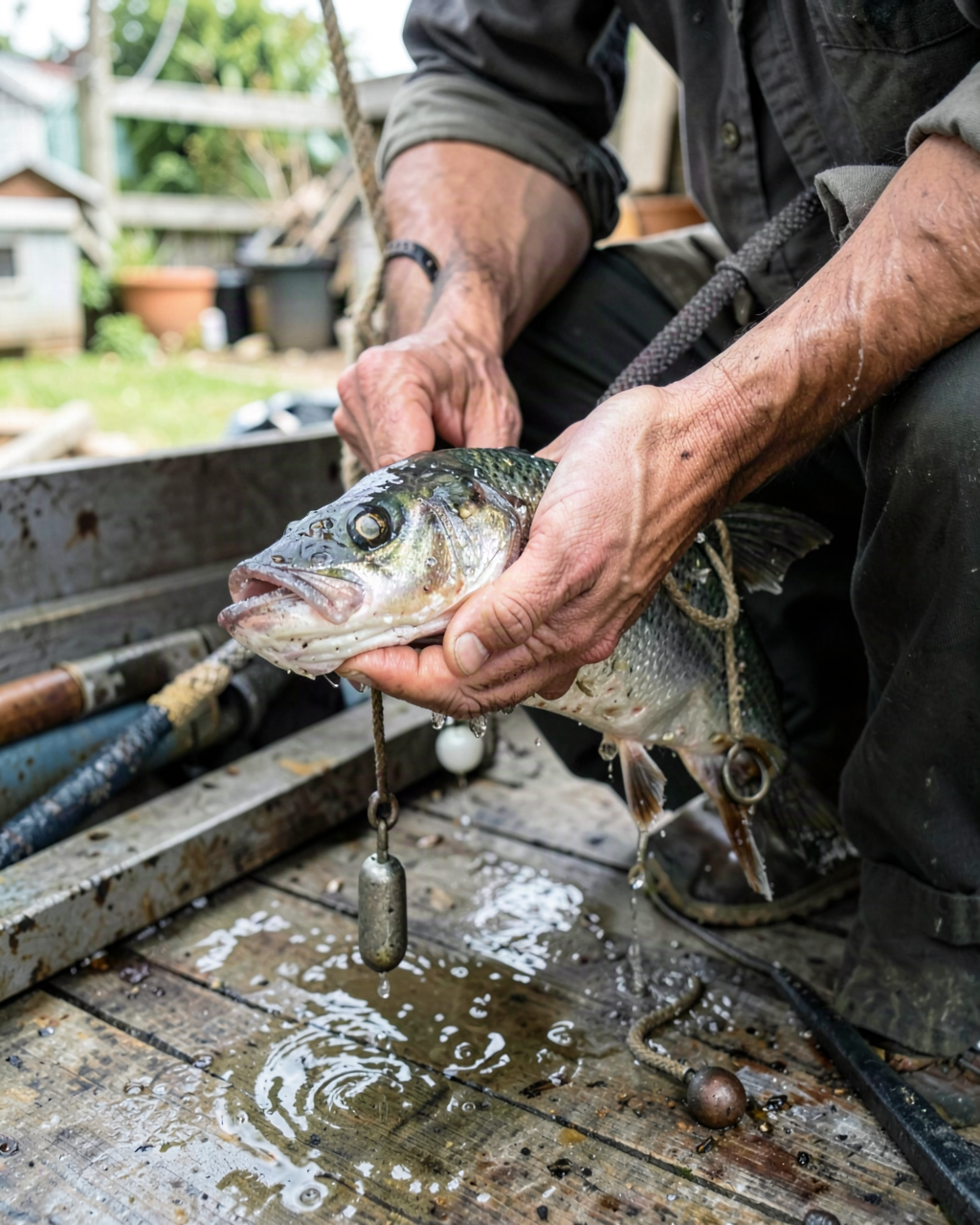
Return 'Em Right's standard package includes a SeaQualizer pre-rigged to a 3-pound weight. Our view: the 16-ounce figure in the rule is a legal floor, not a working weight at depth.
The NOAA bulletin describes weighted-hook devices as attached to an easily accessible, separate rod and reel or handline capable of reeling up a sizable lead — which is a deep drop rod and an electric reel doing what they already do.
DIY builds that match the rule
Home-built gear is explicitly allowed. NOAA's guidance points anglers to an inverted milk crate on a length of rope, and the South Atlantic device table lists a homemade weighted hook and an inverted utility crate with a mounted weight. The regulation supplies the dimensions that matter — 16 ounces of lead at minimum, enough line to reach 60 feet or the depth of capture — and leaves rope material, wire gauge and clamp tension to you.
Keeping a descender ready between trips
Keep it rigged: line run, weight on, device clipped within reach, as the rule requires it readily available while fishing. Rinse the device and weight in fresh water after each trip, dry the line off the reel and check it for chafe, and store the rig out of direct sun.
Frequently asked questions
Does a descending device guarantee survival?
No. No release technique guarantees survival. In NOAA's tagging work bocaccio survived about 90 percent of the time and cowcod about 50 percent.
Is venting still legal?
Yes. The DESCEND Act accepts a venting tool or a descending device in the Gulf, and the South Atlantic rule does not prohibit venting tools for trained users.
How much weight does a descender need?
The South Atlantic definition calls for a minimum 16-ounce weight; Return 'Em Right ships a SeaQualizer pre-rigged to 3 pounds.
What do descenders cost?
About $100 by the Gulf Council's estimate, against $20–40 for a venting device with needles. The Shelton Fish Descender lists at $12.99.
Sources
Research
- Return 'Em Right to Tackle Barotrauma in Reef Fish
- Return 'em Right to Tackle Barotrauma in Reef Fish
- How Descending Devices Can Save North Carolina's Reef Fish
- NOAA Fisheries Announces Gear Modifications for the Snapper …
- Blog – Gulf Fishery Management Council Votes to Extend …
- Rockfish Barotrauma and Recompression | NOAA Fisheries
- Return 'Em Right to Tackle Barotrauma in Reef Fish
Manufacturer and retailer specifications