
Brand: Blackfin Rods · Country: USA · Location: Hobe Sound, Florida · Category: trolling and stand-up rods
Blackfin Rods is one of the most Florida-specific brands in this category. The company designs and handcrafts Fin Legacy rods in Hobe Sound and builds around familiar South Florida techniques: ballyhoo trolling, high-speed wahoo, tuna stand-up fishing, teaser pitch fishing, swordfish and mixed offshore work.
The Fin Legacy range does not chase ultra-light graphite construction. Instead, it uses durable E-glass or composite blanks and proven Fuji, AFTCO, Stuart or Winthrop components. That makes the rods heavier than some premium Japanese graphite hybrids but very well suited to charter and boat abuse.
Top 5 Blackfin trolling rods
1. Fin Legacy Pitch Rod — best all-around premium Blackfin
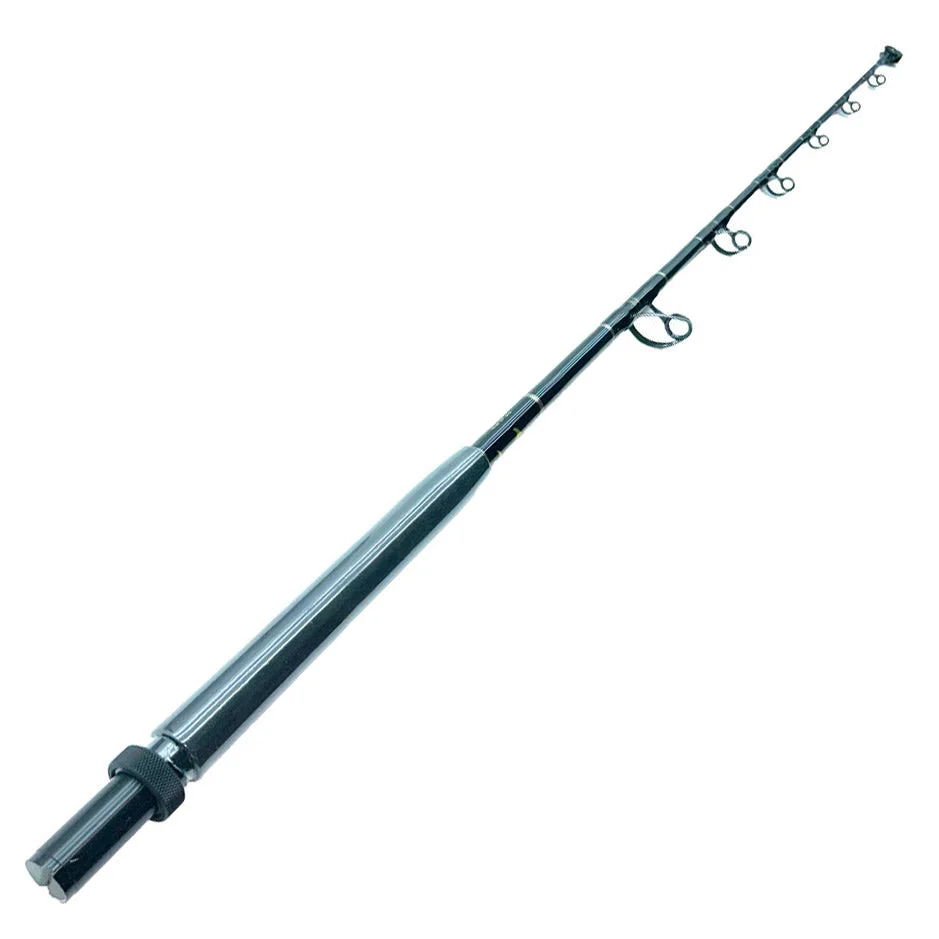
The Fin Legacy Pitch Rod is available in 30 and 50 lb ratings and is designed for pitch fishing marlin off teasers or dredges, trolling, tuna chunking, planer fishing and high-speed wahoo trolling. Blackfin lists the rods around 6’4″ to 6’6″ depending on configuration.
Key hardware includes a Uni-Butt, Winthrop roller top, EVA foregrip and silicon-nitride Fuji guides. Blackfin specifically notes that the guides can handle braid, wire line and passing swivels. A softer tip supports circle-hook techniques while the lower blank provides heavy lifting power.
2. Fin Legacy Stand-Up Rod — best general trolling rod
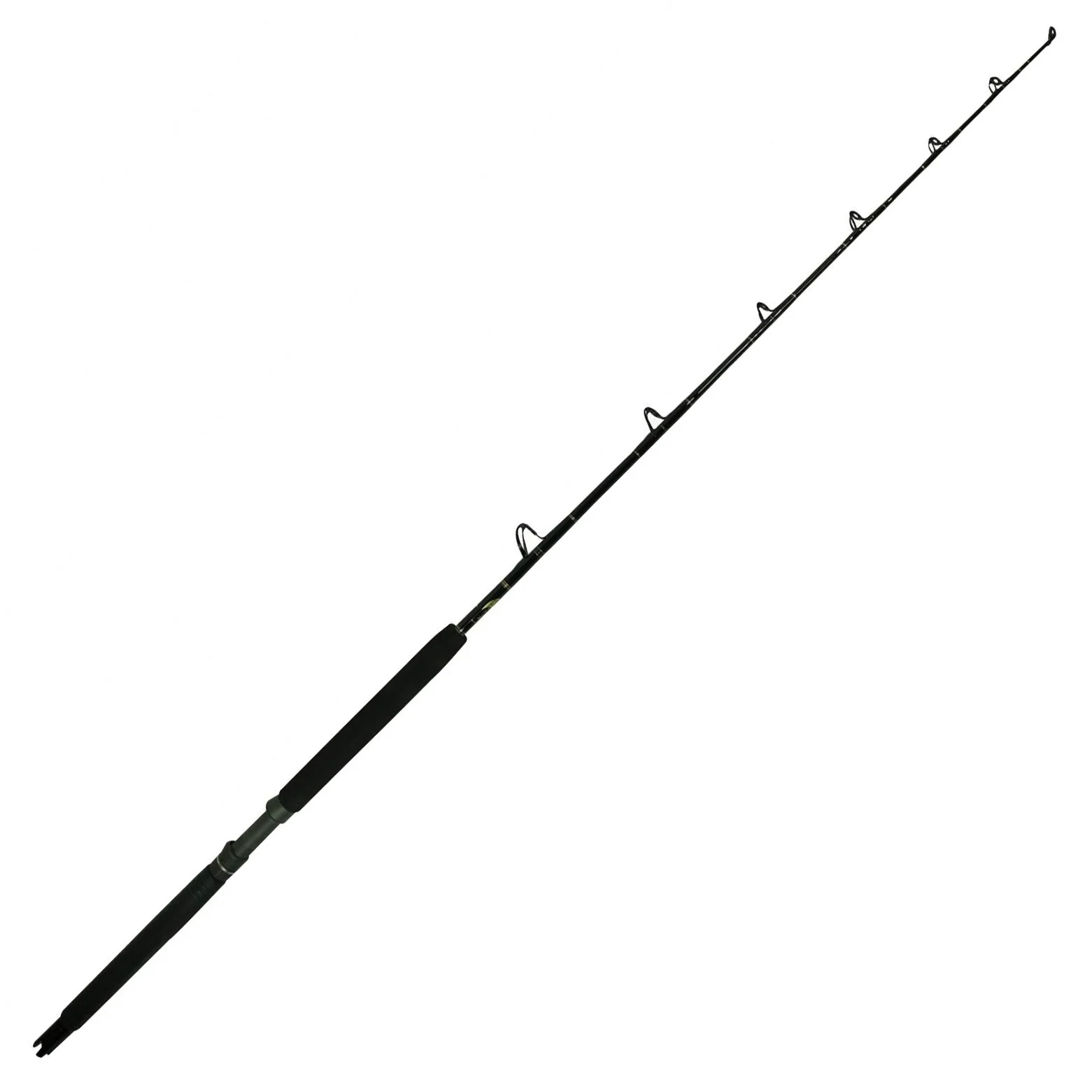
The Fin Legacy Stand-Up comes in 20–30 and 30–50 lb models around 6’6″ with fast actions. Blackfin uses Fuji aluminum-oxide guides, a Fuji graphite reel seat, slick butt, EVA foregrip and metal gimbal.
This is the simplest recommendation for anglers who want one Blackfin rod to troll ballyhoo, small lures and also bottom fish. It is less specialized than the Pitch Rod and significantly less expensive, starting around $279.99.
3. Fin Legacy Strip/Tip Rod — best low-maintenance mono trolling rod
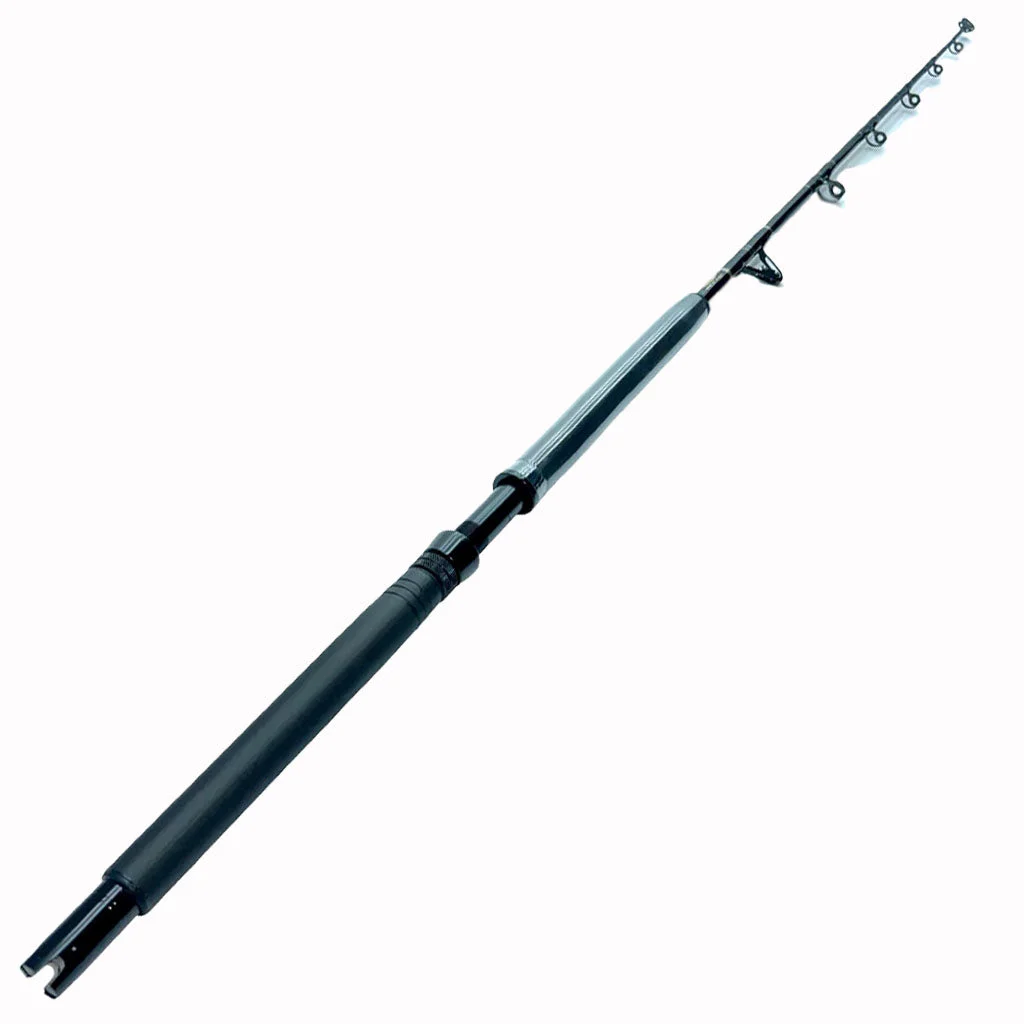
The Strip/Tip rod uses a roller stripper guide and roller tip with Fuji aluminum-oxide ring guides between them. That hybrid system targets the two highest-friction areas without adding the weight and maintenance of a full-roller guide train.
Models include Fin #145 at 5’9″, 20–30 lb, moderate-fast action and Fin #146 at 5’9″, 30–80 lb, extra-fast action. The latter is especially useful for tuna and wahoo where line pressure rises substantially.
4. Fin Legacy Tuna Stand-Up — best heavy tuna and wahoo rod
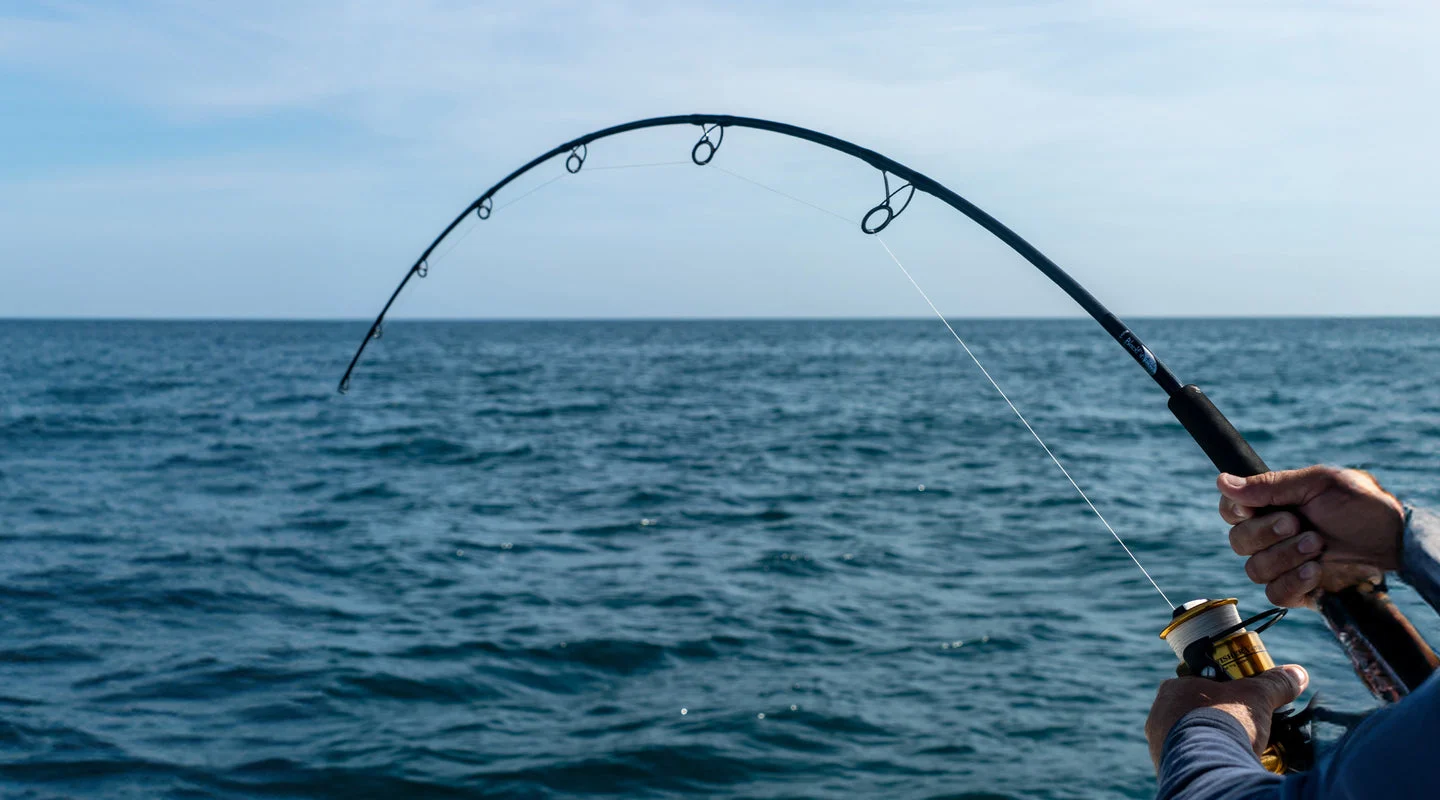
The Tuna Stand-Up family uses full AFTCO roller hardware. Current models include a 30–50 lb Fin #155 at 5’6″ and a 50–80 lb Fin #156L at 6′. Blackfin equips them with AFTCO roller tops, Wind-On Big Game guides, EVA foregrips and #2 Uni-Butts.
These rods are intended for serious drag. Blackfin specifically lists stand-up tuna, high-speed wahoo and nighttime swordfish as applications. Full rollers reduce friction when heavy mono or wind-on leaders are under sustained tension.
5. Fin Legacy Spinning Trolling Rod — best crossover rod
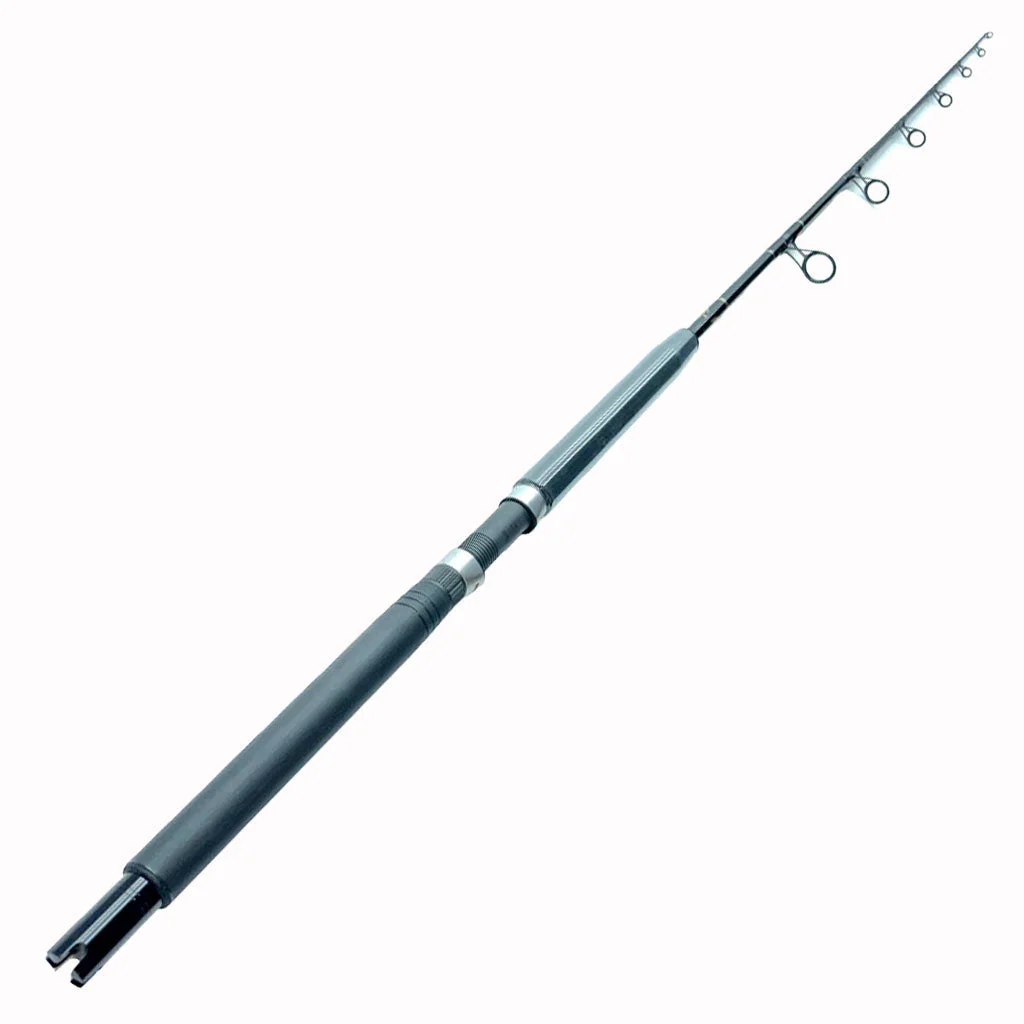
The Fin Legacy Spinning Trolling Rod is unusual because it is designed to troll a bait and then immediately become a sight-casting or pitch rod when mahi or sailfish appear. Blackfin uses a fortified composite blank with enough backbone for trolling but a tip capable of casting live bait, jigs or other presentations.
This is not the rod for a 50W conventional reel or heavy marlin chair work. It is a versatile center-console tool for anglers who value adaptability more than a specialized conventional setup.
Why E-glass still works
Modern rod marketing often emphasizes graphite percentage, but E-glass remains excellent for trolling. It tolerates impacts, bends deeply and absorbs violent strikes without becoming brittle. That durability is valuable on rods that spend their lives bouncing in holders and gunwales.
The trade-off is weight. A full-glass rod generally feels heavier and slower than a graphite or hybrid rod. For trolling, that matters less because the rod spends much of the day in a holder. During the fight, the deeper bend can actually help reduce shock on the leader.
Blackfin’s Florida design philosophy
Blackfin’s model descriptions read like a list of local techniques: ballyhoo, teasers, dredges, planer fishing, high-speed wahoo, tuna and swordfish. That regional focus is useful because Florida trolling does not always fit a generic “50 lb boat rod” category.
A sailfish crew may need soft-tip rods that load naturally on circle hooks. A wahoo crew may need wire-line-compatible guides and blanks that tolerate constant lure pull at speed. A tuna crew may want full rollers and a short stand-up profile. Blackfin addresses those as separate applications.
Pitch Rod in more detail
The Pitch Rod’s Winthrop roller top reduces friction at the tip while ring guides keep the rod lighter through the midsection. The Uni-Butt creates a strong connection to the reel seat and gimbal. This is a logical setup for a rod that may transition from trolling in a holder to being grabbed quickly for a fish on a teaser.
The 30 lb version is better for white marlin, sailfish and lighter tuna. The 50 lb version is better for blue marlin, heavier planer rigs and wahoo. Because both are moderate-fast rather than extremely stiff, the rod can still load smoothly on a circle-hook bite.
Strip/Tip versus full roller
The Strip/Tip model is an intelligent compromise for anglers who want less maintenance. The stripper guide sees a sharp line angle coming off the reel and the tip sees the final angle leaving the rod, so rollers at those positions reduce friction where it is highest.
Full rollers become worthwhile when fishing very heavy mono, high drag or long battles. They also add moving parts that must be cleaned and checked. For 20–30 lb trolling, Strip/Tip is usually simpler. For 50–80 lb tuna, the full-roller Tuna Stand-Up makes more sense.
Stand-Up Rod: why 6’6″ works
At 6’6″, the standard Fin Legacy Stand-Up is longer than many heavy tuna sticks. That length helps with ballyhoo trolling and line separation and gives the tip more cushioning. The 20–30 and 30–50 lb ratings cover most recreational South Florida trolling.
The downside is leverage. A 5’6″ tuna rod is easier for the angler to pull against than a 6’6″ rod. That is why Blackfin shortens the dedicated Tuna Stand-Up models as line class rises.
Tuna Stand-Up and AFTCO hardware
The all-roller Tuna Stand-Up family is built around friction control. AFTCO Wind-On Big Game guides are designed to pass wind-on connections while keeping rollers aligned under heavy pressure. The #2 Uni-Butt gives a rigid lower section for harness use.
For 50–80 lb line and heavy drag, this is a much better system than placing a large two-speed reel on a light graphite reel seat. The extra hardware weight is justified by the load.
Spinning Trolling Rod: a true crossover
On center consoles, anglers often encounter a school of mahi or a sailfish on the surface while conventional trolling rods are already deployed. A spinning trolling rod reduces the need to keep a separate heavy spinner rigged.
The compromise is that no crossover rod is as specialized as a dedicated conventional troll rod or dedicated casting rod. But for limited rod storage and run-and-gun fishing, that versatility can be valuable.
Florida model selection
Sailfish and mahi: Fin Legacy Stand-Up 20–30 or Spinning Trolling Rod.
Wahoo: Fin Legacy Pitch 50 lb, Strip/Tip 30–80 or Tuna Stand-Up 50–80 for high-speed work.
Yellowfin tuna: Pitch 50 lb or Tuna Stand-Up 50–80.
Marlin: Pitch Rod for teaser/pitch work; Tuna Stand-Up or heavier custom Blackfin builds for sustained heavy drag.
Swordfish: Tuna Stand-Up can serve in nighttime and manual applications, though dedicated deep-drop rods may be better for heavy daytime weights.
Pairing with reels
The 20–30 lb Stand-Up pairs well with compact 16–20 size reels. The 30–50 lb models fit 20–30W lever drags. Tuna Stand-Up 50–80 rods can carry 30W–50W class reels. Always match actual strike drag rather than reel capacity alone.
Blackfin’s heavy hardware can support serious reels, but an 80W or 130-class reel belongs on a rod specifically built for that size, often with a bent or heavy aluminum butt.
Maintenance
E-glass blanks are tough, but guides and hardware still need care. Rinse salt from roller frames, reel seats and gimbals. Check ring guides for cracks and rollers for free rotation. Slick butts should be inspected for wear from rod holders.
Because these rods are often handcrafted and customized, keeping a record of model number and components helps if service or replacement hardware is needed later.
Warranty and customization
Blackfin currently advertises a one-year warranty and offers personalization and custom-rod services. The company operates from Hobe Sound, Florida, which is useful for local anglers who prefer dealing directly with a regional builder.
Custom text is available on some production rods, while fully custom builds can change hardware, line class and configuration beyond the catalog models.
Price and value
Standard Fin Legacy Stand-Up rods start around $279.99. Strip/Tip models are around the low-$300 range, while Pitch and full-roller Tuna Stand-Up rods move into the $400-plus range depending on configuration.
Compared with premium Japanese rods, Blackfin often puts more of the budget into durable hardware and local handcrafting rather than ultra-light carbon construction. For trolling, that can be a smart trade.
Pros and cons
Pros: Florida-specific designs, handcrafted production, proven E-glass durability, excellent roller and hybrid-guide options, custom support.
Cons: heavier than premium graphite-hybrid rods; some specialized models are less widely stocked than mass-market brands.
Frequently asked questions
Which Blackfin trolling rod is best for most anglers?
The Fin Legacy Stand-Up 30–50 lb is the most versatile conventional choice.
Which is best for high-speed wahoo?
The Tuna Stand-Up 50–80 or heavier Pitch/Strip-Tip models.
Are Blackfin rods made in Florida?
The company states that Fin Legacy rods are designed and handcrafted in its Hobe Sound, Florida facility.
What is the advantage of Strip/Tip guides?
They place rollers at the highest-friction points while keeping lighter fixed guides through the middle of the rod.