
Do deep drop lights work? Honest answer: sometimes, and it depends on what’s on the end of the line. A small LED can make a baited rig more noticeable, but being noticeable does not automatically make it more attractive. Some fish approach artificial light. Others avoid it. Still others show no useful change in catch rate.
That leaves anglers with a more practical question: does this particular light improve catches of this particular species under these particular conditions? Research gives us reasons to experiment, but it does not support treating every flashing accessory as a guaranteed advantage hundreds of feet below the boat.
What the Research Actually Says
Before discussing a “2022 review of LED fishing lights,” one detail needs correcting. The broad review frequently cited in 2022 fishing research is Nguyen and Winger’s Artificial Light in Commercial Industrialized Fishing Applications: A Review, published in 2019. The 2022 Yellow Sea paper that cites it is an experimental study of illuminated trammel nets, not a review or a test of recreational deep drop rigs.
That distinction matters. Evidence from a net, crab pot, or surface fishing vessel cannot simply become evidence for a light clipped above a baited hook in deep water. These systems expose fish to different light patterns, deep drop fishing gear, and opportunities to approach or escape.
Nevertheless, the broader research establishes an important point: artificial illumination can change fishing outcomes. The direction and size of that change depend on the animal and the application. A successful light for one fishery can be ineffective, or counterproductive, in another.
Why a Light Might Help
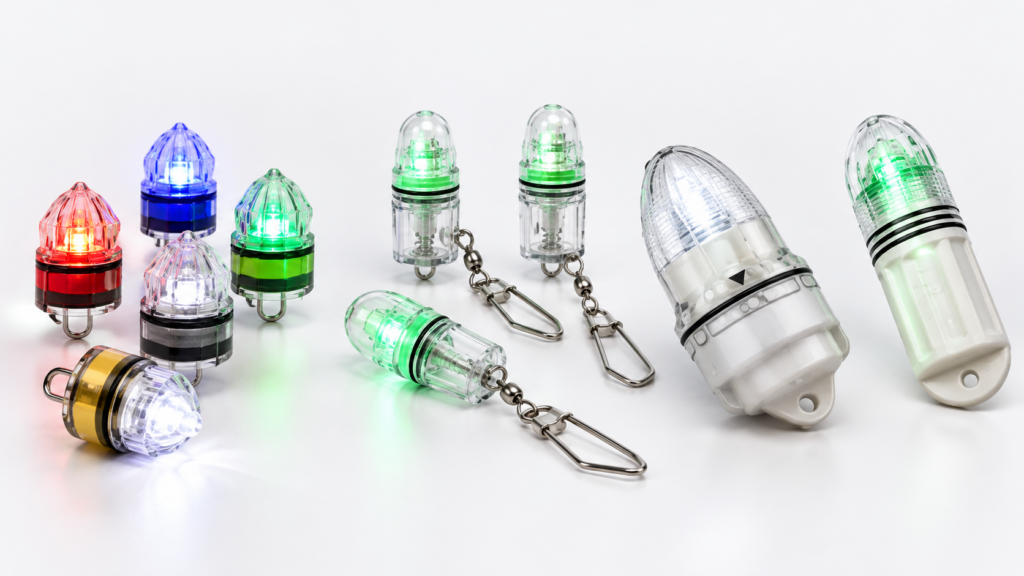
The most straightforward explanation is visibility. Where ambient light is weak, an LED creates contrast. A fish that detects the glow might investigate the area, notice nearby bait, and eventually take a hook. This is a plausible mechanism, rather than proof that every deepwater predator responds favorably.
There are several possible steps between seeing a light and getting caught. The fish must approach within useful range, encounter the bait, decide to feed, and become hooked. A light could improve one step without improving the final result. It might attract attention while also making the leader or other hardware easier to detect.
Nor should anglers assume a tiny rig light builds the same food chain seen around an illuminated dock. A stationary dock light and a moving deep drop rig operate at different scales and timescales. During a short drift, the useful effect may be local curiosity or bait visibility, rather than a developing concentration of prey.
Why a Light Might Hurt
Darkness does not make every fish eager to investigate brightness. NOAA researchers reported strong negative responses to artificial lighting in sablefish and some rockfishes, even at low light levels. That finding is a clear warning against the assumption that deepwater fish universally welcome LEDs.
It does not prove that every recreational rig light reduces sablefish catches, because laboratory behavior and fishing performance are different measurements. However, it gives anglers a credible reason to test an unlit presentation when targeting species that may avoid illumination.
Research using lights on trawls also demonstrates that illumination can reduce catches of certain fish. Sometimes that is exactly the goal: researchers want unwanted animals to avoid the gear or find an escape route. For an angler targeting those animals, the same behavioral response could be undesirable.
The lesson is simple: a light changes the presentation. Whether that change helps depends on the fish.
Positive Results Need Context
In the 2022 Yellow Sea study, researchers tested blue, green, red, and white LEDs on trammel nets targeting seven commercial species. They found that responses were species specific and size dependent. Some catches improved, but the effect was not uniform across the animals being sampled.
Those trials took place in water roughly five to thirty meters deep. They provide evidence that LED color and species can matter, but they do not establish an ideal color for tilefish, snowy grouper, or other recreational deep drop targets.
Hook and line evidence also deserves attention. A Newfoundland study of green LED attachments on Atlantic cod handlines found no significant improvement in catch efficacy, despite promising earlier pilot work. The paper appeared online in 2022 and in a 2023 issue of Fisheries Research.
That is useful evidence precisely because the outcome was inconclusive for anglers seeking higher catches. A reasonable biological idea, and encouraging preliminary results, did not translate into a demonstrated advantage in the follow-up study.
Does Color Make a Difference?
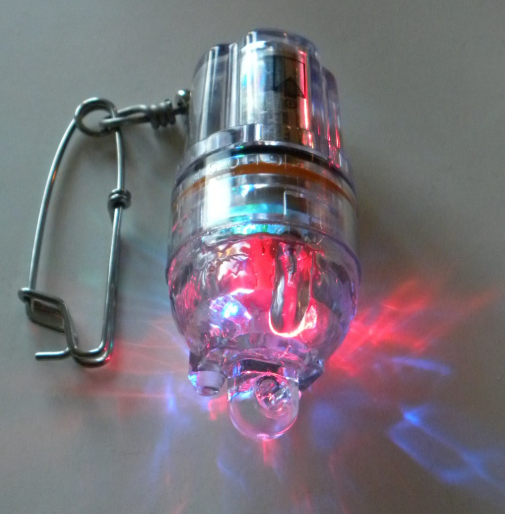
Color is worth considering, but there is no defensible universal winner for all deep drop fishing. The relevant questions include which wavelengths the target detects, how the water transmits them, and whether the animal approaches or avoids that signal.
An LED carried down on the rig produces light at fishing depth. Its output does not need to travel from the surface to the bottom. Therefore, the familiar observation that sunlight loses different colors as it descends does not mean a red LED stops emitting red light when lowered deeply.
What matters is how far that locally emitted light travels and how the fish perceives it. A bright-looking lamp on deck may not produce the most useful underwater signal. Human judgments about brightness are also an imperfect guide to another animal’s vision.
Treat color as a variable to investigate. Keep the rest of the setup consistent before deciding that one shade outperforms another.
Brightness, Flashing, and Placement
More light is not automatically better. Increased output might improve detection, but it might also increase avoidance. Likewise, flashing could draw attention or make an already unusual presentation less acceptable. Without a relevant comparison, neither steady nor flashing illumination deserves an automatic preference.
Placement introduces another variable. A light above the hook cluster creates a different presentation from one attached immediately beside a bait. Distance, orientation, and the rig’s movement influence which parts of the setup receive illumination.
For a first experiment, use one repeatable mounting position that keeps the light clear of hooks and branch lines. Avoid changing its color, brightness, position, and flash pattern together. Otherwise, a better catch will tell you little about which change mattered.
Think of this as tuning the presentation, with the understanding that the best setting may ultimately be no light.
The Rig Still Has to Fish Properly
Before blaming an LED for poor results, examine the fundamentals. Is the bait reaching the intended zone? Is current carrying the rig away from productive bottom? Are the hooks exposed and the baits staying attached? Does the leader arrive without tangles?
A light cannot compensate for fishing outside the area occupied by your target. It also adds another component that can snag, foul a branch line, or fail under pressure. Practical reliability matters as much as the theoretical attraction mechanism.
Choose equipment with a documented depth rating suitable for the planned drop. Check the housing, seals, attachment, and battery before deployment. A waterproof accessory intended for shallow use should not be assumed capable of surviving deepwater pressure.
These checks do not establish catch effectiveness. They ensure that your experiment actually compares a functioning illuminated rig with an unlit one.
How to Test Lights Honestly
A productive afternoon with an LED proves that fish can be caught while using it. It does not establish that the LED caused the catch. Fish abundance, drift path, bait quality, feeding activity, and time on bottom can all change between drops.
Alternate comparable lit and unlit drops over several trips. Use the same hook arrangement, bait type, fishing area, and approximate depth. Record the target species landed, unwanted catch, fishing time, light settings, and obvious changes in conditions.
If two rigs fish simultaneously, remember that the illuminated rig could influence fish near its neighbor. Swap rod positions where practical, and avoid assuming that side-by-side fishing removes every source of bias.
Judge performance by target catch relative to comparable effort. Also note bait loss and tangles. An occasional extra bite may offer little practical benefit if the attachment repeatedly disrupts the rig.
For anglers comparing reports, ask whether the claimed benefit came from measured fishing effort or simply memorable catches. A photograph shows success, but a record of comparable drops helps identify improvement. That distinction is especially useful when evaluating enthusiastic product descriptions and dockside advice. Keep those records even when the outcome seems obvious.
Are Deep Drop Lights Worth Using?
They are worth a controlled trial when their cost and handling demands are acceptable. They are worth keeping when repeated comparisons support a useful improvement for your target. They are worth removing when results deteriorate or the added hardware becomes troublesome.
The honest answer remains “sometimes.” Research supports species specific responses to artificial light, including attraction, avoidance, and no demonstrated catch benefit. It does not support a blanket promise for recreational deep drop rigs. Start with a sound presentation, test one change at a time, and let repeatable results decide whether the glow earns its place.