Grouper fishing in Florida covers the whole state and most of the water column. This guide follows a day on the water in order: the species, the rules, the season, the rigs, the drop, the fight and the release.

The range is what sets Florida apart. Most anglers meet two or three grouper species and stop looking. The boats that come home heavy are the ones willing to change depth band, bait and rig as the tide moves, instead of grinding one mark until the current dies.
Note
Management of the red grouper fishery runs through NOAA Fisheries and the Gulf, South Atlantic and Caribbean fishery management councils. The boundary written into the federal yellowtail-snapper hook exemption runs due west from 25°09′ N off the west coast of Monroe County.
What Makes Grouper Fishing in Florida Different
The depth spread
Say "grouper" in Florida and you are describing several fisheries stacked by depth.
Each band has its own boat speed, its own weight and its own idea of a long run. Shifting up a band mid-trip is usually a change of rig and weight rather than a change of plan, which is why a crew that carries a spread of weights and leaders can follow the fish instead of the clock.
Why depth decides everything
Depth sets your main line, your leader length, your weight, your hook size and how fast you can get a fish off the bottom. It also sets how the fish comes up. A grouper hooked deep can arrive bloated and unable to swim back down on its own. That single difference is why the deep half of this fishery runs on release gear as much as on rod and reel.
What this guide covers
The sections that follow work from the outside in: the species and where each one lives, the rules you have to carry, the season as it actually runs, then the rigs, the drop sequence, the fight, the release and the boat systems that make a deep day possible. Where a figure comes from a manufacturer or a regulator it is attributed to them, and where something is our own judgement it is labelled as ours.
The Florida Grouper Species You Will Meet
Gag grouper (Mycteroperca microlepis)
Gag grouper is an important component of the reef-associated grouper species complex of the Gulf of Mexico and the South Atlantic, according to the SEDAR review of gag tagging data. It is the fish most Florida anglers picture when they say the word grouper: a shallow to mid-depth species that takes live bait on the bottom and fights hard for the first thirty feet.
Black grouper (Mycteroperca bonaci)
Black grouper shares water with gag and red grouper and is one of the species that benefits from the habitat red grouper builds. NOAA Fisheries describes red grouper as marine engineers that excavate flat-bottom areas and create habitat for species such as spiny lobster, black grouper, red porgy and vermilion snapper. Black grouper is a heavy, deep-bodied fish that commits to structure hard, which is why the first ten seconds of the fight matter with it more than with anything else on this list.
Red grouper (Epinephelus morio)
Red grouper is the workhorse of the Florida west coast. NOAA Fisheries reports that the Gulf stock is not overfished, and the fishery is managed with annual catch limits that close it when the limit is projected to be met. UF/IFAS notes on red grouper put the common depth range at 10 to 300 feet, with fish found as deep as 1,000 feet, and describe a preference for hard bottom: reefs, ledges, rocks, crevices and artificial wrecks.
Scamp grouper (Mycteroperca phenax)
Our view: Scamp grouper (Mycteroperca phenax) turns up on the same ledges, usually a little deeper and usually alone rather than in a pack. On a slow day it is often the fish that saves the trip, and on a deep drop it is the one that comes up alongside the tilefish.
Yellowmouth grouper
Yellowmouth grouper is the small one most anglers never name. Florida's Department of Agriculture lists it on nearshore reefs off the northeastern coast and on offshore reefs in the Gulf, and puts a common size of about twenty pounds on it.
Snowy grouper (Hyporthodus niveatus)
Snowy grouper is one of the two species this article treats with electric tackle, and the rig for it is covered in full below.
Yellowedge grouper (Hyporthodus flavolimbatus)
Yellowedge grouper shares that deep hard-bottom world with snowy grouper and is handled the same way: a weighted leader, heavy braid, a reel that winds under load, and a descending device ready for anything you do not keep.
Goliath grouper (Epinephelus itajara)
Goliath grouper is the giant of the family, the largest grouper species in western Atlantic waters, and its range runs from Florida and the Gulf through the Bahamas and the Caribbean as far south as Brazil. The Gulf Council's goliath grouper page sets out the federal rules: the species is closed to possession or harvest, it must be released immediately with minimum harm, at least one dehooking device must be used to remove hooks, and anglers fishing for reef fish must have a venting tool or descending device rigged and ready to use.
The bycatch you will meet: mangrove snapper and amberjack
Mangrove snapper and amberjack come up on the same rigs as grouper, in the same places, and fall under the same release-gear rules. Treat them as part of the same problem rather than a separate fishery: if you are rigged for grouper over reef, the hook rules and the descending-device requirement already apply to whatever you hook.
Grouper Fishing in Florida Regulations Before You Leave the Dock
Licences and the State Reef Fish Angler designation
A Florida fishing licence is required to land any saltwater species in the state, whether the fish was caught in state or federal waters, and the licence carries a fee, with fishing from the shoreline the free exception. Both are registered through the FWC's online licensing system. Before you target reef fish recreationally, check the FWC's current page for the State Reef Fish Angler designation and confirm what it asks of you; the requirement is the agency's, not this article's.
Circle hooks and gear rules
In the Gulf, fishing for reef fish with natural bait requires non-stainless steel, non-offset circle hooks, along with a dehooking tool and a descending device on board when you are in federal waters. The federal rule is written the same way, with one narrow exemption that allows other non-stainless hook types for commercial yellowtail snapper fishing south of the line running due west from 25°09′ N.
Venting tools, descending devices and the DESCEND Act
The DESCEND Act took effect on 13 January 2022 and requires anglers to have a venting tool or descending device on board while reef fishing in Gulf of Mexico federal waters. Return 'Em Right, the coalition behind much of the training and gear distribution, describes barotrauma as a pressure injury: gas in the body cavities and tissues expands as the fish comes up, displaces organs and leaves the fish bloated and unable to get back down. A Florida Sea Grant descending project found that at depths of 100 to 119 feet, most red grouper, eighty percent of them, were unable to descend on their own.
Where the Gulf line falls
The practical takeaway is that Florida is two rulebooks, and the boundary is a line rather than a coastline. NOAA Fisheries and the Gulf, South Atlantic and Caribbean councils manage the red grouper fishery, and the boundary in the federal hook rule is drawn due west from 25°09′ N off Monroe County. Confirm the current text with the FWC, NOAA Fisheries and the relevant council before you rely on it, because the dates and the boundaries are the agencies' to change.
Florida Grouper Season: Reading the Calendar
Why the season is set by spawning
Grouper seasons are set around spawning and stock health rather than around the weather, which is why an open window can fall in a hot month and a closed one in the best fishing of the year. Any month-by-month calendar you build has to be re-checked against the current year's rules before you plan a trip, on each coast separately.
Gulf of Mexico grouper fishing
On the Gulf side, the autumn belongs to gag. Florida Sea Grant's grouper posts featured gag grouper for September and noted that the fish have a limited fishing season. Winter belongs to red grouper: the same programme named January as the month for the species, with cold water bringing the fish into shallower water. That fits the biology, since red grouper favour deeper water when it is warm and move shallower as it cools.
Atlantic and Florida Keys grouper fishing
On the Atlantic side, red grouper is managed under the South Atlantic Snapper-Grouper Fishery Management Plan. Gag grouper is part of the reef complex on both sides of the state, so the species list looks familiar even when the season dates do not. The Keys add the deepest options in Florida: the run past the reef edge puts you over snowy and yellowedge water inside a day trip.
Where Florida Grouper Live
Grouper are structure fish before they are anything else, so where you find hard bottom in the right depth band is where you find grouper. The areas below are the ones Florida anglers plan around most often, from the shallow limestone of the northern Gulf to the deep reef line off the Keys.
Natural bottom: ledges, rock and hard ground
Grouper want structure, and in Florida that means hard bottom, with the fish sitting on or just above the ocean floor. The best marks are often a single ledge edge rather than a broad patch, because that is where current is compressed and bait is concentrated, and because a fish holding on an edge has somewhere to retreat to.
The Florida Middle Grounds
The Florida Middle Grounds is the offshore live-bottom area most Gulf grouper crews plan a trip around, a broad region of coral and rock structure well out into the Gulf. Our view: it earns its reputation less because the fish are bigger there and more because the structure is concentrated enough to hold fish through a tide change when a single ledge will not.
Nature Coast, Crystal River and Homosassa
The Nature Coast, with Crystal River and Homosassa at its southern end, is the shallow end of the grouper range: limestone rock, springs and hard inshore bottom inside an easy run. It is gag and red grouper country, and it is where a small boat can fish grouper without a long run or a heavy rig.
The Florida Keys and the Atlantic reef line
The Florida Keys and the Atlantic reef line offer the deepest grouper fishing in the state without leaving the shelf. The reef edge drops away quickly, so the same boat can fish a shallow ledge in the morning and be over snowy and yellowedge water by the afternoon with nothing more than a change of rig and a change of weight.
Working a published artificial-reef coordinate
Published artificial-reef numbers are starting points, not the fish. Treat a posted coordinate as the centre of a search area, and let the boat and the sounder tell you where the structure actually sits:
- Run to the numbers and slow down early, watching the sounder for the top of the structure instead of driving over it at speed.
- Mark the up-current edge first, because that is where bait and current meet and where fish hold.
- Set a drift that carries you across the structure once rather than through it, and note the heading the boat tracks.
- Drop on the next pass with the boat positioned so the rig lands on the mark as the line comes tight, then log the heading and the depth so the drift can be repeated.
How to Build a Grouper Rig
Leader first
Build the rig from the leader back to the rod, not the other way around. The leader is what the fish sees and what the rocks cut, so choose the material and the length for the depth and the bottom, then size the hook and the weight to it, and only then pick the main line that has to carry the whole assembly down and back.
Knots and the line-to-leader connection
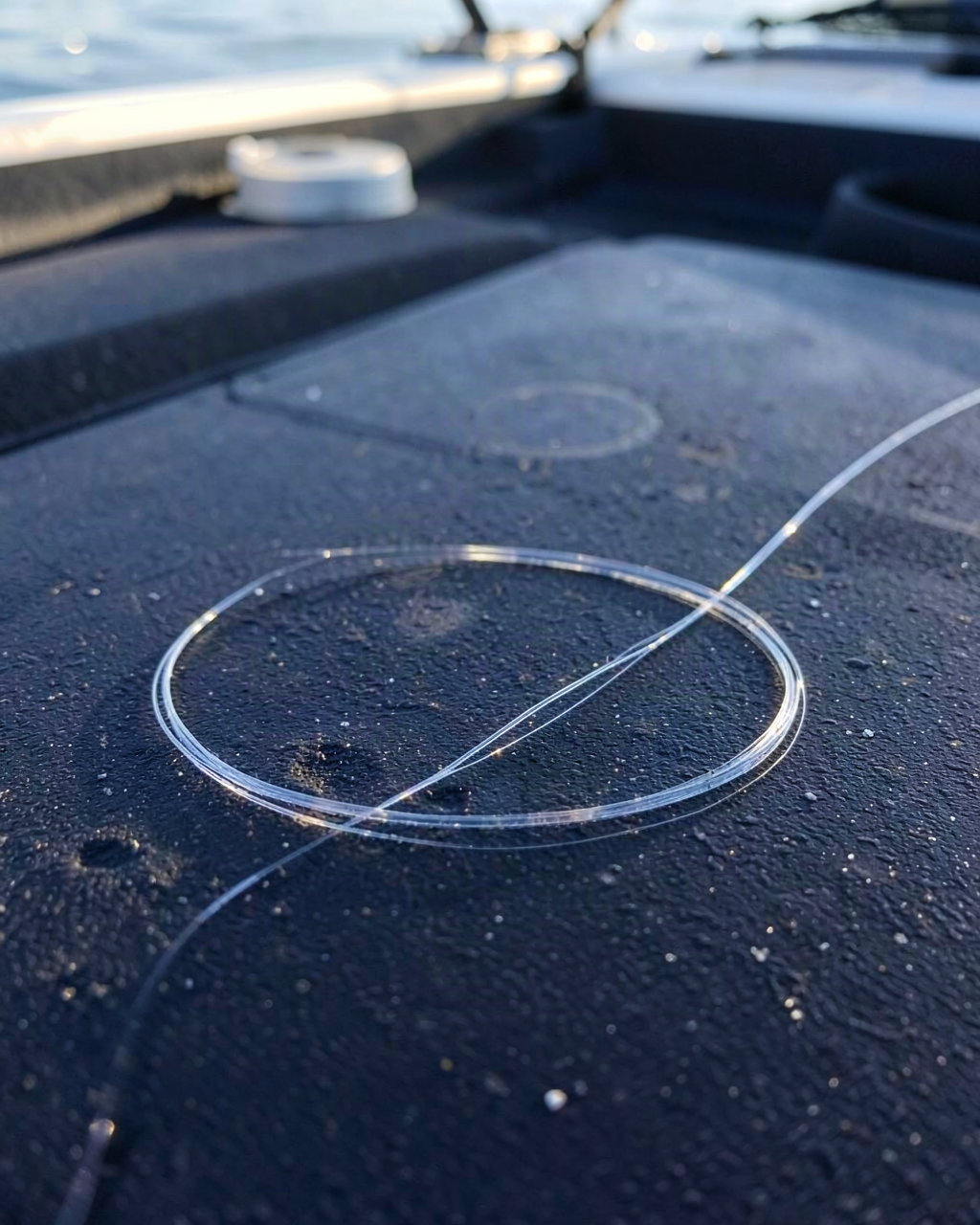
Every rig lives or dies at the join between the braid main line and the leader. A short, tight, well-seated knot tied with wet line and pulled down hard is worth more than a heavier leader with a sloppy join. Tie the connection fresh each trip, because a knot that has been dragged across rock once is a knot you cannot trust a second time.
Hooks, weight and bait placement
For natural bait in the Gulf the hook is settled for you: non-stainless, non-offset circle hooks are required when fishing with natural baits. Size the hook to the bait rather than to the fish, keep the weight above the leader instead of on the hook, and hold the bait on the bottom where the fish are feeding rather than letting it swing up in the current.
The shallow-water bottom rig
For gag, black and red grouper in fifty to a hundred and fifty feet, a simple bottom rig is enough: a sliding weight above a swivel, a leader of a few feet, and a circle hook baited with a live pinfish, a grunt, a strip of squid or a chunk of octopus. UF/IFAS lists pinfish, grunt, squid, octopus, shrimp and crab among good red grouper baits, and notes that a jig head tipped with squid also works.
Deep-Drop Tackle for Snowy and Yellowedge Grouper
What nine hundred feet does to tackle
Depth multiplies everything. Line stretch becomes a factor you can feel, the weight needed to hold bottom climbs into pounds, and the number of drops you can make in a day is set by how fast the reel retrieves rather than by how fast you can wind. This is the part of grouper fishing where the equipment, not the technique, decides the day.
Rods that carry heavy lead
A deep-drop rod has a narrow job: carry heavy lead and the weight of the reel all day, survive the rod holder, and still absorb a fish that lunges at the surface. Look for a short, powerful blank with a bent butt or heavy roller guides rather than the light-tipped rods you would use inshore. Our view: buy for the weight you will actually fish most often and accept that a rod rated far above it will feel dead on the drop.
Electric reels and the power question
Electric reels are what make snowy and yellowedge grouper a practical target rather than a stunt. They wind a weighted rig and a fish up from deep water, drop after drop, which is the difference between a day of fishing and a day of winching. Our electric reels directory groups the makers with a page for each, and it is the place to start matching a reel to the depth you plan to fish.
Line class and leader matched to depth
Line class and leader follow the depth band rather than the fish you hope to meet. A shallow bottom rig for gag and red grouper wants a leader of a few feet; a deep drop wants a longer, heavier leader that reaches the structure ahead of the main line and takes the abrasion first. Pick the leader for the bottom you are fishing, then bring the main line up to match it, and keep the two consistent from one trip to the next so you learn how each behaves.
Braid, sink rate and sensitivity
Braid is the default main line for deep dropping because its thin diameter lets a heavy weight reach bottom in current that would hold thicker line off the structure. The trade-off is that braid does not stretch, so every knock on the bottom and every change in the drift reaches your hand almost undamped. Mark the line so you can read depth without staring at a counter, and check the last few feet for abrasion after each contact with rock.
Slow-Pitch Jigging for Grouper
Why grouper eat a falling jig
Slow-pitch jigging is built on the fall. Our view: on a slow-pitch jig the strike usually comes as the jig flutters, glides or slides back down rather than on the lift, which is why the cadence matters more than the retrieve. A grouper that will not chase a bait up through the water column will still open on a jig that falls past its nose, and that is the whole reason the technique works on structure.
Rod and reel for jigging grouper
Our view: a slow-pitch rod is short and whippy, with a recoil that throws the jig up so the angler barely lifts, and the reel that suits it is a compact conventional with a smooth drag and enough line capacity for the depth. Spool it with braid, add a short leader, and let the rod do the work the angler's wrist would otherwise do. The slow pitch jigs directory covers the jig side of the same decision.
Jig weight by depth and current
Jig weight is chosen by depth and current, not by the fish. The heavier the jig, the faster it falls and the less time it spends gliding; the lighter the jig, the more it flutters but the longer it takes to reach bottom in current. Carry a spread and change weight as the drift speed changes, rather than changing jig every time a fish refuses.
The cadence
The cadence is one lift, then a controlled fall on a tight line, then a pause, repeated as the jig works the structure. Keep the rod tip low and the line tight enough to feel the fall, because the bite on a falling jig is often nothing more than weight where there was none a moment before.
Baits and Presentations
Natural baits
Natural bait remains the most reliable way to put grouper in the boat, and the best baits are the ones already living on the structure. Live pinfish and grunts are the standard, with squid, octopus, shrimp and crab as the cut and frozen alternatives. Match the bait to the hook size and keep it fresh, because a bait that has been sitting in the sun is a bait a grouper will leave alone.
Jigs and artificials
Artificials come into their own when the fish are pressured, the current is too strong for a bait to sit still, or you want to cover water rather than hold one spot. A jig head tipped with squid is a useful bridge between the two approaches, and a slow-pitch jig covers water while it falls. The advantage is speed of presentation; the cost is that a jig will not soak in one place the way a bait will. Our view: on a tough day, carry both and let the current decide which one you fish.
The Drop, Step by Step
A deep drop is a sequence, and getting the order right is most of the skill. The boat has to be right before the rig leaves the rail, and the rig has to be right before the fish arrives.
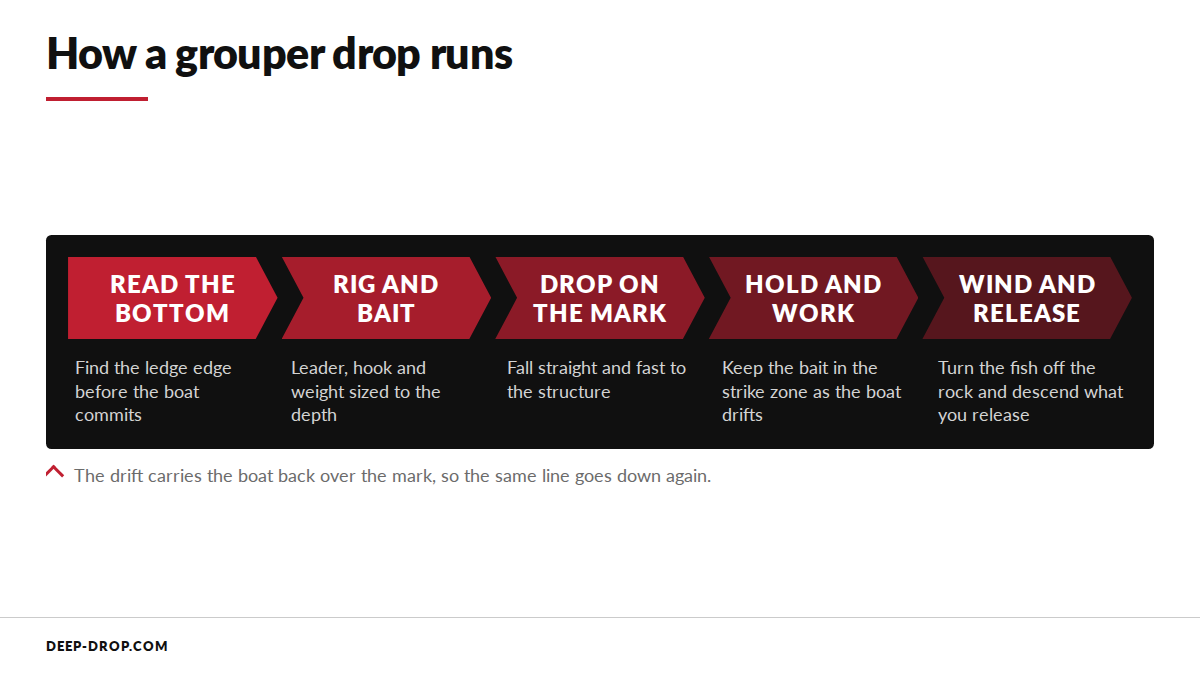
- Set up before you drop. Position the boat so the drift carries you onto the mark rather than past it, and get the rig moving before the structure slides off the screen.
- Drop straight and fast. Keep the line vertical over the weight, because a rig that swings out behind the boat lands somewhere else entirely.
- Touch down, then lift. Feel the weight hit, then lift it a turn or two so the bait sits just above the structure instead of buried in it.
- Stay on the structure. Watch the drift and adjust the weight so the bait stays where the fish are, rather than letting it climb off the edge.
- Wind, and keep winding. Once a grouper is hooked it will try to get back into the rock, so the only answer is a tight line and a fish coming up.
The two mistakes that cost the most fish are dropping while the boat is still moving over the mark and letting the bait lift off the structure as the drift accelerates. Both are boat-handling problems rather than tackle problems, and both are fixed by watching the sounder and the line together.
Drifting or Anchoring?
Drifting covers more ground and suits a sounder search for the productive edge of a wreck or a ledge. Anchoring holds one spot and keeps the bait in the strike zone while the boat stays put. On the deep drops most Florida crews drift, because anchoring in a thousand feet is impractical and because a slow drift keeps the rig working across the structure. For shallow grouper on a small rock, anchoring is often the better answer.
Choosing the Day: Weather, Current and Tide
Three things decide whether the day is worth running:
- Wind against current, which stacks the sea and makes a clean drift impossible.
- Drift speed over the structure, which sets how much weight you need and how long the bait stays in the zone.
- Tide stage at the mark, because the bite usually follows the movement rather than the slack.
Sea state, drift speed and tide stage decide more than any tackle choice. A day with a fast drift and a short tide window is a shallow-bottom day; a long slack window over deep structure is a deep-drop day. Read the forecast and the tide before you choose the depth band, and be willing to run shallow when the current will not let you hold deep.
After the Bite: Hook, Fight, Land
The first ten seconds
The first ten seconds decide most grouper fights. A hooked grouper turns straight back for the rock, and if it reaches a crevice with line still in your hand, the fight is over. Put the rod in the holder or under your arm, take the slack out immediately and wind, because the fish that is moving up is the fish you land.
Drag you can repeat
Set the drag by feel once, at the rail, and then leave it alone. A drag you have to guess at is a drag that either breaks you off on the first run or lets a fish back into the rock. Pull line off the reel by hand before you start, feel where the drag is, and note the setting so you can repeat it next trip.
Barotrauma, and what to do before a fish floats
Anything you are not keeping, and anything you are releasing because it is out of season or closed, has to get back to the bottom. A fish that floats away on the surface is a fish that does not survive, and the Return 'Em Right material describes that float as the visible end of barotrauma. Have a venting tool or a descending device rigged and ready rather than stowed in a bag, and use it immediately instead of after a photograph.
Boat Power and Wiring for Deep Drops
Battery packs
A portable lithium pack frees an electric reel from the boat's wiring: clip the pack to the reel, and you can fish a deep drop from any boat rather than only one with a dedicated 12-volt circuit. Our electric reel batteries directory covers the packs and the makers. Size the pack to the number of drops you plan, and charge it the night before.
Wiring and connections
If you run an electric reel from the boat, the wiring is the weak point. Undersized cable, corroded terminals and loose connectors all cost voltage under load, and lost voltage shows up as a reel that stalls with a fish on. Use the cable size the reel maker specifies, keep the terminals clean and dry, and check the connections before every deep trip.
Lights
Deep drops start early and often finish late, so deck and navigation lighting is part of the job rather than an accessory. Have enough light to tie a leader and read a knot without holding a torch, and keep a headlamp within reach of the hook box.
What a Grouper Trip Costs
Cost is where grouper fishing in Florida separates a short day from a full offshore run. Our view: the biggest swing in the cost of a grouper day is fuel and ice, not bait, and the second biggest is how far you have to run to reach structure that has not been fished hard that week. Tackle spend sits mostly at the start, where a deep-drop reel, a heavy rod and a battery pack are one-time costs that then spread across every trip you make. The honest way to budget is to price the run in fuel first and then decide what the day can afford to fish.
Frequently Asked Questions
How deep do you fish for grouper in Florida?
Red grouper are caught from about 10 to 300 feet, and can be found as deep as 1,000 feet. Snowy and yellowedge grouper are deep-water fish, pursued well past the depth where a hand-wound bottom rig is practical.
What is the best time of year for grouper fishing in Florida?
There is no single best month, because the species run on different windows. Gag grouper is a fall fish on the Gulf coast with a limited season, and red grouper are a winter target when cold water moves them shallower. Our view: the deep species are worth pursuing year-round by any crew willing to make the run.
Do you need a descending device to fish for grouper?
In Gulf of Mexico federal waters, yes. Since 13 January 2022 the DESCEND Act has required a venting tool or descending device on board while reef fishing, and anglers fishing for reef fish must have one rigged and ready to use. Gulf federal reef fishing also requires a dehooking tool.
Can you keep a goliath grouper in Florida?
No. In federal waters the species is closed to possession or harvest, and it must be released immediately with minimum harm, which means cutting the line rather than lifting the fish from the water.
Planning the Next Drop
Grouper fishing in Florida rewards a plan that changes with the day. Start with the current rules, pick the depth band the weather and the drift will let you fish, rig for that band, and keep the release gear where you can reach it. If the tackle side needs sorting first, browse the tackle shop before the next run.
Sources
Research
- Red Grouper
- Grouper, Goliath
- Review of Tagging data for gag grouper (Mycteroperca …
- Gulf Coast Catch and Cook January: Red Grouper
- Grouper Types
- Free Gear Available for Gulf Reef Fish Anglers to Help Reef …
- Florida Sea Grant Fish Descending Project Final Report
- grouper Archives – What's Happening Around Florida