
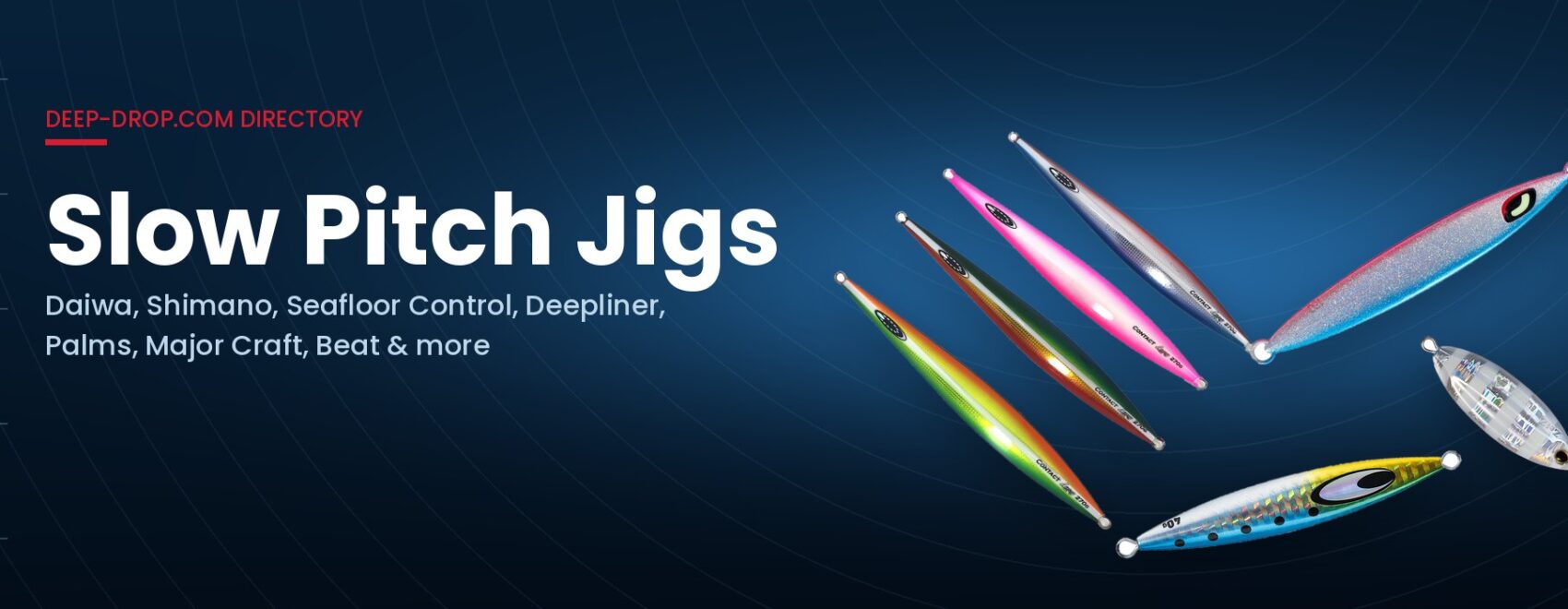
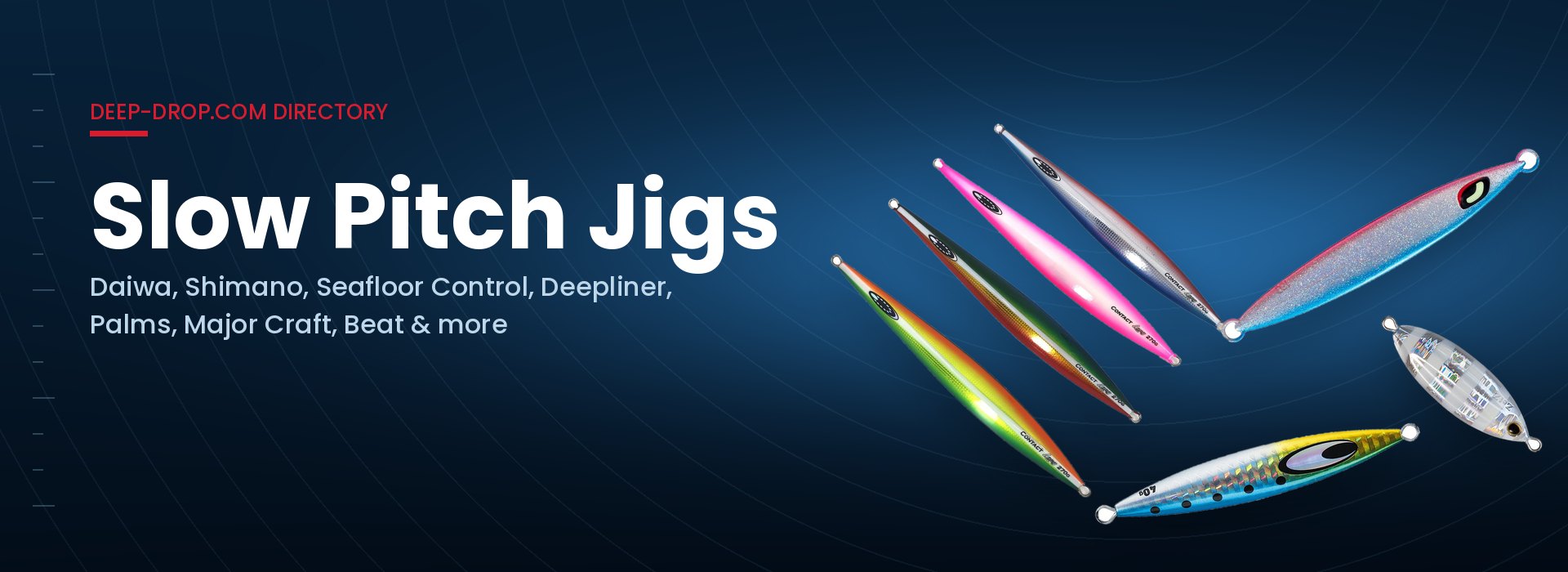
Slow pitch jigs are built to fall: most strikes come as the jig flutters, glides or slides back down after the rod throws it up. The shape decides the action, so serious jiggers carry several models for different current and depth. Japanese makers (Seafloor Control, Deepliner, Beat, Shimano) set the standard; Taiwanese, Australian and other brands offer value options.
This page lists every company in the Slow Pitch Jigs category of the Deep Drop Directory: 10 companies from 3 countries. Every company now has a full review, linked below.
Full reviews
- Daiwa Slow Pitch Jigs Review
- Deepliner Slow Pitch Jigs Review
- Seafloor Control Slow Pitch Jigs Review
- Shimano Slow Pitch Jigs Review
- Beat Slow Pitch Jigs Review
- Major Craft Slow Pitch Jigs Review
- Jigging Master Slow Pitch Jigs Review
- Nomad Design Slow Pitch Jigs Review
- Ocean’s Legacy Slow Pitch Jigs Review
- Palms Slow Pitch Jigs Review
Slow Pitch Jigs companies
| Company | Country | Key product lines | Website |
|---|---|---|---|
| Daiwa (Globeride) | Japan | Saltiga SK Jig (20–300 g, $10.99–$21.99), MR Slow Jig, FK Jig, Saltiga TG Bait; Saltiga SL Jig SD (Japan) | daiwa.com |
| Deepliner | Japan | Spy, Spy-N, Spy-V, Slow Skip FB/CX/Vib | deepliner.com |
| Seafloor Control | Japan | Spunky, Arc, Abyss, Arrow, Cranky, Rector, Messiah, Gawky, ASH, AMU | seafloor-control.com |
| Shimano | Japan | Ocea Stinger Butterfly Sardine Waver, Butterfly Flat-Fall, Butterfly Flat-Side | shimano.com |
| Beat | Japan | Zigray (80–200 g), Greatray (130–350 g), Beeline (110–270 g), Baby Zigray (VARIVAS) | beat-jigging.com |
| Major Craft | Japan | Jigpara Slow (10–100 g, hooks included), Jigpara Vertical Long Slow (100–500 g), Vertical Slow Pitch, Vertical Quell ($8.99–$18.99) | majorcraft-america.com |
| Jigging Master (JMaster) | Taiwan | Fallings Special, Breathing Devil Eye (150–300 g), Diamond VIP Long/Short (to 600 g), Gangster Jig | jiggingmaster.com |
| Nomad Design | Australia | Buffalo (80–320 g, pre-rigged, $14.99–$22.99), Gypsea, Buffalo Jr. | nomadtackle.com |
| Ocean’s Legacy | Australia | Long Contact (30–270 g), Hybrid Contact (40–260 g), Deep Contact (300–1,100 g) | oceanslegacy.com |
| Palms | Japan | Slow Blatt S/R (40–500 g), L (40–300 g), Slow Blatt Cast Oval/Slim/Long | palmsjapan.com |
What to look for
- Choose jig weight by depth and current: heavier when it runs hard.
- Short, flat jigs flutter slowly; semi-long jigs slide and cover water.
- Glow finishes help in the low light of deep water.
- Many premium jigs ship without hooks. Budget for assist hooks.
← Back to the Deep Drop Directory
Listings are compiled from manufacturer websites and dealer listings and updated regularly. Spotted an error or want your company listed? Contact us.
Slow Pitch Jigs: The Professional Guide to Shapes, Tackle and Techniques
Technical guide • Updated October 8, 2026
- The useful question when selecting a slow pitch jig is whether you can make it perform its intended action at the fish’s depth. A beautiful fluttering jig that never reaches the reef vertically is a poor choice.
- A streamlined jig that reaches bottom but is too heavy for the rod to release is another mismatch. This guide connects jig design, rod recovery, reel pickup, line diameter, hooks and boat control, with recommendations grounded in manufacturer specifications and instruction from established jigging professionals.
- The directory and brand reviews above remain your model reference. Use this guide to decide which category to buy and how to fish it.
- Recommendations below are conditional selections, not claims that one brand always catches more fish. “Micro/light jigging” is the shallow-water method discussed here; “macro jigging” is not used as a standardized technique name. For the pelagic section, the intended targets are blackfin tuna, bonito or little tunny, king mackerel, other mackerel and jacks.
History, Origins and Evolution
- Metal-jig fishing predates modern slow-pitch jigging. The specific Japanese system associated with Norihiro Sato shifted attention toward the jig’s horizontal transition and descent, especially when fish were reluctant to chase.
- Japanese Angler’s Secrets identifies Sato as the founder and documents instruction from him and the wider Team Sato. The important historical contribution was a coordinated presentation system: a responsive rod, measured handle turns, thin PE line, falling jigs and a hook arrangement suited to bites during that fall. It was more than simply retrieving a conventional jig slowly.
- That distinction explains the evolution of modern tackle. Manufacturers now offer separate rods and jigs for slow pitch, long fall, high pitch, super-light jigging and heavy deep-water work.
- Deepliner’s current product material explicitly distinguishes those applications rather than treating every metal jig as interchangeable. Its Logical and Mania Fellows families illustrate different ways to control delicate or heavy presentations. The practical development has been specialization around the action required at depth.
- Outside Japan, the method became established in fisheries where bottom species and pelagics overlap. American professional Benny Ortiz has documented its application around South Florida, the Dry Tortugas and Pulley Ridge.
- Today, anglers can choose Japanese specialist tackle, locally supported American equipment, Australian jig designs and compact tungsten options. Modern adaptations also include rods intended to carry more fighting load. Therefore, the fighting instructions for a traditional slow-pitch blank should not automatically be transferred to every modern “power slow” rod.
For terminology and a broader introduction, read What Is Slow Pitch Jigging?. For manufacturer comparisons, continue with our Deepliner, Seafloor Control and Shimano jig reviews
Core Types of Slow Pitch Jigs by Shape and Action
- Shape, balance and material are three different variables. “Center-balanced” describes the location of mass along the jig; “asymmetric” describes unequal surfaces or geometry.
- A jig can possess both properties. A long jig can still flutter, and a wide jig can still sink effectively when its weight and the conditions suit it. Select from the manufacturer’s action description, then confirm the action with the hooks you actually intend to use.
Swipe the table sideways to compare all columns.
Jig selection by presentation problem
| Category | Useful action | Professional selection | Reason to change |
|---|---|---|---|
| Wide, flat or leaf-style | Broad flutter and slower descent; extended falling presentation. | Controlled drift, limited current, fish responding to a suspended or falling target. | Line scopes away before you can work the fish’s depth. |
| Asymmetric / balanced sliding designs | Sideways travel, roll or backslide according to the individual model. | Reaction presentation with deliberate rod release and space for the jig to move. | Excessive leader wraps, uncontrolled travel or poor bottom contact. |
| Narrow, dense and long-drop | Efficient descent; less water resistance than a comparable broad profile. | Deeper water, faster drift or current where reaching the target takes priority. | The jig reaches depth but no longer offers the fall fish are responding to. |
| Tungsten / compact micro profiles | More mass in a compact body; action still depends on geometry. | Small baitfish profile while maintaining useful sinking weight. | Hooks overwhelm the small body, or weight exceeds the light rod’s rating. |
Wide, Flat and Leaf-Style Jigs
- Johnny Jigs’ Flatty, also described as “Flattie” in its instructional material, is a clear example of a high-flutter choice for low current and controlled drift. Its ultra-flat profile sacrifices descent speed to create a pronounced falling presentation.
- Carry it for bottom fish when you can preserve contact without repeatedly feeding line. Start with this action when a slow descent is useful; switch profile when water movement prevents delivery.
- Flat Back is another Johnny Jigs model to compare, but its name should not be taken as proof that its balance, surfaces and action are identical to Flatty. Read the individual weight and hook specifications. A practical buying approach is to carry a broad flutter model and a more efficient sinking model at comparable weights, rather than buying several colors of the same shape first.
Asymmetric and Center-Balanced Jigs
- Shimano’s Butterfly Wing-Fall offers several named falling movements, including rolling, swinging and backsliding, and is described for both speed and slow-pitch use. That is a more useful selection criterion than assuming every asymmetric jig must spin or tumble identically. Choose it when you want a moving fall, then alter pitch size and pause to see which transition produces bites.
- Seafloor Control offers a substantial specialist range, including Arc, Abyss and Rector. Compare those through the Seafloor Control review and the manufacturer’s model descriptions. Do not select an unfamiliar model solely because another jig has a similar outline: edge shape, thickness and mass placement can produce different lifting resistance and fall behavior.
Narrow, Long-Drop and Torpedo Jigs
Johnny Jigs Torpedo belongs in the low-flutter, efficient-descent category. Its professional instructional material recommends lower-action profiles when current and drift make high-flutter jigs difficult to control. The priority is delivering a controllable lure to the target, not maximizing visible flutter near the surface.
- Ocean’s Legacy Long Contact needs a more precise classification: the manufacturer describes a long, center-balanced jig with quick descent and retained flutter. It is a useful long-profile option, including for powerful pelagic and seriola targets, but it is not simply a tail-weighted torpedo with no falling action. Compare it through our Ocean’s Legacy review
- Shimano professional material identifies Shimmerfall as a slender option for deeper water and faster drift. It belongs on the shortlist when a broad jig cannot reach or remain in the working zone. Use the actual weight range your rod can animate; increasing weight without matching the rod defeats the reason for changing jigs.
Tungsten Micro Jigs
- Major Craft Jigpara Vertical TG provides a compact tungsten alternative to a larger lead profile. It is relevant when bait is small or fish reject a bulky presentation, but “TG” does not mean every weight in the range is a micro jig.
- Pick the physical length and weight together. Keep rings, hooks and assist cord proportionate: oversized hardware can substantially change a small jig’s presentation.
- Tungsten is useful for compact delivery; it does not guarantee a particular flutter pattern or solve poor boat positioning. See our Major Craft review
Selection and Setup: Match the Whole System
The One-Gram-Per-Foot Starting Rule
- Benny Ortiz’s professional account gives approximately one gram of jig weight per foot of depth as a starting heuristic and explicitly says it can vary widely. At 200 feet, that suggests testing a jig around 200 grams; it does not establish a requirement.
- His overriding criterion is staying vertical. He also documents queen snapper jigging at 750 feet and the importance of reel pickup and capacity in this fishery.
- Use the heuristic to choose your first test, then assess three observable results: how quickly the jig reaches the working depth, whether bottom contact remains recognizable, and whether the rod releases the jig after each pitch. If delivery fails, consider a narrower profile, greater weight within the rod rating, thinner suitable braid or a corrected drift.
- If delivery works but the rod stays loaded, change the rod/jig pairing or reduce lifting resistance. The answer is not always more grams.
- A strongly angled line also makes a surface pitch an unreliable description of the jig’s movement. Current can differ through the water column, so the angle at the boat does not show every bend in the line.
- Avoid feeding additional line indefinitely to keep touching bottom. Recover and reset when control is lost; a fresh drop often offers a more meaningful presentation than dragging a supposed slow-pitch jig behind the boat.
Rod and Reel Choices
- For dedicated slow pitch, assess Shimano Game Type Slow J and Daiwa Saltiga Slow Pitch Jigging alongside specialist rods such as the Deepliner rod families. Start your wider comparison in the slow-pitch rod directory.
- Buy the actual model rated for your intended jig weight and method, not simply the strongest blank in a series. Power numbers from different manufacturers are not equivalent.
- A compact conventional reel allows direct spool control during descent and measured handle turns during the pitch. Prioritize reliable free spool, usable retrieve under load, capacity at your selected line diameter and a drag that can be adjusted smoothly.
- Compare application-specific options in our slow-pitch reel directory, including Shimano Ocea Jigger, Daiwa Saltiga and Accurate Valiant SPJ. Use the conventional reel directory for a broader comparison.
- In deep water, calculate capacity after accounting for the entire drop, drift-induced extra line and a fish’s run. Nominal capacity at a different braid diameter is not a usable reserve calculation.
- Record actual loaded capacity, braid diameter, leader specification, rod model and jig weight as one outfit. Keep the rod maker’s maximum drag and fighting-angle guidance with that record. A reel capable of high drag does not establish what the rod, knots, small hooks or thin main line can tolerate.
Slow-Pitch Jigging Line: Braid and Leader Recommendations
What Matters More Than a Brand Name
- Use PE braid for direct contact and efficient depth delivery. Compare diameter, breaking-strength convention, construction, marking intervals and spool length.
- A PE number is a size designation, not a universal conversion into pounds of strength. Likewise, “maximum” breaking strength and a nominal line-test label are different claims. VARIVAS’ own product tables show separate PE sizes and stated strengths, illustrating why cross-brand shopping requires the actual specification.
- Depth-marked line is especially useful when fish suspend or when you need to repeat a productive band. Check the marking system: some lines use meters, others feet, and color cycles can repeat.
- Keep a count beyond the first cycle. PowerPro’s published comparison distinguishes Depth-Hunter applications from unmarked lines and other constructions; do not assume every braid in a brand’s catalog has the same depth markings.
Japanese and Japan-Origin Braid Shortlist
These are established product families worth comparing for jigging. Local catalogs and available spool lengths differ. Brand origin does not establish the manufacturing country of every individual product.
Swipe the table sideways to compare all columns.
| Brand | Braid to evaluate | Selection purpose |
|---|---|---|
| VARIVAS | Avani Jigging 10×10 Max Power PE X9; X8 | Dedicated marked jigging line; compare listed size, strength and length. |
| YGK / XBRAID | Super Jigman X8; Jigman Ultra X8 | Purpose-built offshore jigging families with multiple PE sizes. |
| Sunline | Saltimate Infinitive X8 | Saltwater jigging option; select adequate length for the intended depth. |
| Shimano | Ocea 8 | Dedicated offshore PE; verify the current regional specification. |
| Daiwa | J-Braid X8 Grand Multi-Color | Accessible multicolor choice with published diameter and strength data. |
| Gosen | Answer Jigging X8; Roots PE X8 | Compare jigging-specific marking and length against general-purpose options. |
| DUEL / Yo-Zuri | SuperBraid 9 Five Color; SuperBraid Five Color | Marked offshore alternatives; confirm sufficient usable capacity. |
Popular US-Market Braid Alternatives
Swipe the table sideways to compare all columns.
| Brand | Products / official reference | Practical qualification |
|---|---|---|
| PowerPro | Depth-Hunter, Depth-Hunter Offshore, Super Slick V2, Maxcuatro | Choose marking system and diameter deliberately; these are distinct constructions and applications. |
| Sufix | 832 Advanced Superline | Established braid option; verify length and depth-marking needs before deep jigging. |
| Berkley | ProSpec Chrome Braid and metered braid | Saltwater catalog includes different solid and hollow options; select the intended construction. |
| SpiderWire | Stealth Smooth Braid | General braid alternative; verify spool length and marking rather than assuming a deep-jigging specification. |
| Diamond / Momoi | Diamond braided-line range | Offshore supplier offering braid and leader systems; match the individual product to the application. |
| P-Line | EndurX | General braid option; compare actual diameter and available length. |
- These tables cover major Japanese and American-market choices, not a claim that every brand or regional product has been cataloged. For professional slow-pitch selection, the first comparison should be marked offshore PE of suitable diameter and sufficient length. A familiar casting braid can work, but familiarity does not replace checking those requirements.
Leader Brands and Material Choices
- Fluorocarbon and nylon both have legitimate applications. Choose the specific material for diameter, handling, abrasion exposure and the required presentation.
- Fluorocarbon is not literally invisible, nylon is not automatically unsuitable, and neither is reliably tooth-proof against king mackerel. For repeated cutoffs, discuss a short purpose-built bite leader with the captain and accept that additional stiffness or hardware can change the lure’s movement.
Swipe the table sideways to compare all columns.
| Brand / market | Leader families to compare | Professional selection note |
|---|---|---|
| Seaguar, Japan-origin / US market | Blue Label, Gold Label, Fluoro Premier | Compare the actual diameter and spool length; these are separate fluorocarbon products. |
| Sunline, Japan | Saltimate System Shock Leader FC; NY | Fluorocarbon and nylon alternatives within an offshore leader system. |
| VARIVAS, Japan | Shock Leader Fluorocarbon; Shock Leader Nylon | Match the specific leader’s material and size to the outfit; do not infer it from the braid brand. |
| Shimano, Japan | Ocea Jigger Master Fluoro | Jigging-focused fluorocarbon choice with regional specifications. |
| Daiwa, Japan | J-Fluoro Samurai; regional offshore leader ranges | Manufacturer’s super-light jigging guidance uses a fluorocarbon leader with J-Braid. |
| Gosen, Japan | Roots FC Leader | Fluorocarbon alternative; check rated size and diameter. |
| DUEL / Yo-Zuri, Japan | H.D. Carbon Leader | Dedicated leader rather than assuming any fluorocarbon main line is the same product. |
| Berkley, US market | ProSpec Chrome 100% Fluoro Leader; Big Game mono leaders | Professional saltwater fluorocarbon and nylon choices. |
| Sufix, US market | Advance Fluorocarbon Leader | Dedicated leader material; choose diameter for abrasion exposure and presentation. |
| Momoi / Diamond, Japan-origin and US offshore market | Hi-Catch Xtra-Hard; fluorocarbon and wind-on leaders | Hard nylon and assembled wind-on alternatives; account for stiffness and connection bulk. |
| P-Line, US market | PelagX and other dedicated leader products | Select a leader-rated product in the required strength; Tactical main line is not a heavy offshore leader substitute. |
| ANDE, US market | Leader-material range | Established mono and leader supplier; select the individual material and diameter for the rig. |
Connections and Inspection
- Japanese Angler’s Secrets recommends the PR knot with a bobbin and the FG as a tool-free alternative. The practical recommendation is to master one compact braid-to-leader connection, test it with your actual lines, and remake it when damaged.
- Do not treat published ideal knot-efficiency claims as a guarantee for your knot. Tie the leader to an appropriate solid ring or connector, keeping the leader away from a split ring’s opening.
- Inspect the first leader section after contact with rock or a fish’s mouth, and inspect braid where it passes through the connection. Replace compromised material rather than compensating with lower drag and hoping.
- Spool braid evenly under controlled tension. Keep a small record of failed connections: the break location often tells you more than changing brands without identifying the cause.
Assist Hooks: Types, Rigging and Professional Shortlists
- Traditional slow-pitch hook systems often use paired assists at both ends. Totos’ professional hook study explains the importance of penetration during falling bites and the relationship between hook wire, jig action and interference.
- A heavy hook that suits a forceful speed-jigging strike may be poorly matched to a delicate slow-pitch fall. Conversely, a fine-wire slow hook is not automatically suitable for heavy drag against a powerful fish.
Choose the Hook Arrangement for the Situation
- Front twin assists: a practical starting arrangement for slow pitch and many light-jigging presentations. Match gape, wire and cord length to the jig.
- Front twins plus a rear single: adds a rear hooking opportunity with less hardware than two rear hooks. Confirm the front and rear hooks cannot interlock.
- Twin assists at both ends: a traditional falling-bite arrangement where the bottom and jig geometry permit it. More hooks create more potential interference as well as more hooking points.
- Front only around heavy structure: omit rear hooks when snag risk warrants it. This reduces one snagging opportunity; it does not make the jig snag-proof.
- Strong front single or twins for speed jigging: prioritize the intended fish and drag, with a cord length that keeps hooks working near the head rather than wrapping around the jig.
- Short micro assists: use light, proportionate hardware. Large rings, long heavy cords and oversized hooks can dominate a compact lure.
- A common functional connection is leader to solid ring, assists attached to the solid ring, and jig attached through a suitable split ring. Assemble rear assists as the maker intends.
- Check every ring closes completely after installation. Pull the rig straight, then fold and move the hooks through their likely travel to look for overlap.
- Replace damaged cord immediately, particularly after toothy fish. Hook size numbers are not standardized across brands; compare actual dimensions.
Japanese Assist Hooks And Suppliers
Swipe the table sideways to compare all columns.
| Company | Verified product family | Useful starting application |
|---|---|---|
| Owner / Cultiva | Jigger Light Twin Shiwari JT-27; Jigger Light Shiwari and Hold | Dedicated slow-pitch hook selection. Owner instructor material describes Hold at the front and Shiwari at the rear for falling bites. |
| Decoy / Katsuichi | Twin Pike DJ-88; Twin Pike Hyper DJ-98 | DJ-88 for light-jigging selection; Hyper when a stronger hook is appropriate. Choose the actual size and wire for the outfit. |
| Gamakatsu | Assist 700 Double; Tuned Assist HD | Slow-pitch double and heavier deep-jigging alternatives. |
| Shout! Fisherman’s Tackle | Twin Spark; Hard Twin Spark | Compare flexible and stiffer assembled assists for the intended jig and target. |
| Hayabusa | Assist Hook 096 TIN Double; 133 single/double | Ready-made assists with specified cord lengths; check length against jig geometry. |
| VANFOOK | JIGEN JH-10 and jigging-assist range | Specialist hook choices for assembling or selecting a matched assist rig. |
| Seafloor Control | JAM, JAM Light, LS and Heavy | Different slow-jigging targets and loads; Light and Heavy are not interchangeable recommendations. |
| VARIVAS | Ocean Works SLJ hook range | Super-light jigging options to evaluate with compact jigs. |
| Kinryu | NIQ-PRO | Japanese specialist slow-jigging hooks; compare actual dimensions when building assists. |
For related tackle context, our Gamakatsu review also discusses its assist-hook offering.
Global Manufacturers and Commercial Assist Brands
- BKK offers SF Lentus for demanding slow/deep work and Reefmaster/other jigging families for different applications; compare the precise hook and cord specification. Mustad offers J-ASSIST3 Slow Pitch Double, J-ASSIST4 Light Double and heavier J-ASSIST options. These are substantive alternatives to the Japanese makers, selected by application rather than nationality.
- Ocean’s Legacy sells Stinger Twin-equipped jig products, while Johnny Jigs supplies its own commercially rigged jig and assist combinations. Distinguish the company selling an assembled assist from the company manufacturing the underlying hook. The useful professional check is the finished rig’s hook, cord, ring, length and intended load, not a list that assumes every tackle brand manufactures raw hooks.
Slow-Pitch Jigging Techniques
The Pitch and Release
- In Sato-style instruction, measured handle turns load the rod and its recovery gives the jig its movement. Full, half and quarter turns change the input; the horizontal transition and subsequent descent create the opportunity.
- The angler’s task is to generate an appropriate release rather than maintain continuous upward tension. A permanently loaded rod can tow the jig instead of allowing it to behave.
- Work methodically. Establish the target depth, make a short sequence of repeatable pitches, and observe when contact occurs.
- Change one variable at a time: pitch size, pause, working height or jig profile. Counting pitches is useful, but it is not an exact depth measurement because pickup changes with spool fill and line angle. Use marked line to relate a productive sequence to the sounder’s depth band.
Short Pitch, High Pitch and Long Fall
- Slow pitch, high pitch and long fall are related presentation options. Japanese Angler’s Secrets describes them as variations within the system.
- Shorter inputs can keep the lure working in a compact zone; a more pronounced pitch provides a different displacement; long fall places greater emphasis on the descent after lifting. “Slow” does not mean every movement must occur at the same slow tempo.
- For long fall, lift smoothly and follow the descent deliberately so the jig can fall without being continuously held up by the rod. Restore contact when the fall finishes or is interrupted.
- Excess uncontrolled slack can conceal a bite and encourage tangles. Choose tackle designed for the required movement; long-fall instruction does not authorize lifting a hooked fish with a traditional delicate blank at a high angle.
Recognizing a Falling Bite
- A bite may appear as a sharp tap, unexpected weight, sideways line movement or a fall that stops early. Close the spool or bail as appropriate and recover loose line promptly.
- Establish controlled tension before escalating pressure. A violent swing into a slack line and small fine-wire hooks is a poor substitute for finding contact. Repeat the productive part of the sequence on the next drop instead of assuming the fish took during the entire retrieve.
- Keep fighting advice specific to your rod. Traditional slow-pitch practice commonly relies heavily on the reel, with the rod kept at a modest angle rather than used for high pumping.
- Modern load-bearing slow rods can have different instructions. Follow the rod maker’s limits and use the outfit’s tested drag; reel maximum drag is not your operating setting.
Deep-Drop Jigging in Deep Water: Pulley Ridge and Similar Grounds
- Deep jigging is a delivery-and-control problem before it becomes a cadence problem. The jig must reach the correct terrain with enough direct connection to lift, release and detect a bite.
- Plan for the water column you actually fish rather than the depth printed on a chart. Current layers, boat drift, line diameter and jig resistance can make two drops in the same nominal depth behave differently.
Why Pulley Ridge Is a Serious Jigging Destination
- Pulley Ridge and the adjacent offshore fishing grounds west of the Florida Keys offer the depth range and species variety that make a multi-outfit jigging approach useful. Benny Ortiz’s firsthand professional account documents mutton snapper in shallower water, grouper in deep water and queen snapper on jigs at 750 feet.
- This is credible evidence of the method’s application, not a promise that every ridge, season or drift produces those fish. Pelagic marks higher in the column call for a different presentation from bottom-targeted snapper or grouper.
Jigs and Tackle for Deep Delivery
- When delivery is difficult: start the comparison with Torpedo-style lower-flutter designs or slender deep-water jigs such as Shimmerfall. Carry multiple rated weights, not only a larger version of a broad flutter jig.
- When a long profile with retained fall action is useful: evaluate Long Contact as its own center-balanced design rather than assuming it behaves like Torpedo.
- When the drift is controlled: consider a broader falling presentation if it can reach and remain in the working band. Depth alone does not forbid fluttering jigs.
- For the outfit: select the rod for the real jig weight and action at depth; verify loaded reel capacity, marked line and a controllable drag.
- For terminal tackle: use a hook system suited to the target and intended pressure, with non-overlapping assists. Remove rear hooks where the structure and captain’s experience justify it.
- The selection sequence matters. First establish reliable delivery, then tune the falling action, then tune the cadence.
- Buying a more elaborate jig does not correct a thin reserve of line or an outfit unable to control the required weight. Carry a second suitable setup so you can change delivery characteristics without trying to force one rod to cover every offshore condition.
A Controlled Deep-Water Drop
- Coordinate with the captain. Confirm target species, fish marks, relief, drift direction and the intended drop window before releasing the jig.
- Track the descent. Follow line markings and watch for an interruption before the expected depth. Manage the spool so the jig descends without an avoidable overrun.
- Confirm the bottom. Distinguish an actual touchdown from slack produced by boat motion or a bite. Recover enough line to clear contact before beginning the chosen presentation.
- Fish a defined band. For bottom fish, use a compact repeatable sequence initially. For suspended fish, bring the jig to the marked band instead of automatically returning to bottom.
- Reset when control fades. Reposition or retrieve rather than paying out line indefinitely. Tell the captain when several anglers lose contact, since a drift adjustment can help the entire boat.
- For grouper, the first hooked-fish movements near relief can decide the outcome. Do not let a delicate outfit’s marketing description dictate that you should target large structure-bound grouper with insufficient stopping ability.
- For deep snapper, controlled connection and consistent pressure are especially valuable over a long ascent. Identify the fish before making retention decisions; different snapper, grouper and jack species have different rules.
Protected Habitat and Current Rules
- “Pulley Ridge” is a fishing-region name, not permission to anchor at any coordinate. The current federal rule in 50 CFR 622.74(c)–(d) specifies protected-area boundaries, prohibited gear and bottom-anchoring restrictions for Pulley Ridge South and South Portion A.
- These are specific restrictions; they should not be paraphrased as a blanket closure of all rod-and-reel jigging throughout the broader region. Have the captain check the actual position, applicable fishery rules and current retention requirements.
Micro and Light Jigging in Shallow Water: Snapper and Grouper
- Micro/light jigging uses a compact lure and a matched lighter outfit to present small prey efficiently. It is particularly useful when smaller baitfish are the relevant profile or when delicate movement produces better responses.
- It is not a license to use ultralight tackle against every grouper beside a ledge. Target size, relief and the pressure required to move a fish clear remain part of the outfit decision.
A Manufacturer-Backed Shallow-Water System
- Daiwa’s Harrier Super Light Jigging guidance provides a concrete starting system: spinning models with Saltist MQ or BG MQ reels in the 3000–5000 range, 20–30-pound J-Braid, a fluorocarbon leader, and 20–100-gram Saltiga SK or Zakana jigs. The manufacturer specifically lists grouper, snapper, kingfish, tuna and reef fish among the applications.
- Compare the jig families in our Daiwa jig review. That is a professional manufacturer recommendation for a coordinated outfit, not an automatic prescription for every size of those species. Select the rod power and jig weight within the individual model’s specifications.
- For small compact presentations, compare the lower-weight Jigpara Vertical TG models with lead alternatives of the desired length. Seafloor Control’s Tiny series is another specialist light-jig option to evaluate. Keep a compact efficient sinker and a slower falling choice in the box, because current can force a shape change even in shallow water.
Charter-Captain Evidence: Micro Does Not Mean Shallow Only
- Captain Spencer Kight of DI Reef Monster Charters describes micro slow-pitch fishing with 60–80-gram jigs, lighter spinning outfits, 30-pound braid and a 40-pound monofilament leader. His reported applications include vermilion snapper, triggerfish and almaco jacks in roughly 120–250 feet, with controlled boat positioning.
- The useful lesson is that “micro” describes the presentation and tackle, not a fixed maximum depth. This example should not be converted into a claim that the same weights will reach any reef in any current.
Working Shallow Reef Fish
- For snapper, identify whether fish are holding close to relief or above it before deciding how far to work the lure. Begin with a repeatable presentation in that band.
- A slower falling compact jig is useful only when it stays controllable; if the line is being swept away, change delivery first. Avoid repeated bottom dragging, particularly with rear hooks installed.
- For grouper, position and first-contact control deserve more attention than reducing jig size. Choose a rod, leader and hook that permit the intended pressure within their ratings.
- If the target is a large fish in severe structure, move to an appropriately stronger outfit while retaining a compact jig profile where possible. Small bait does not require weak tackle.
- Use shorter, deliberate inputs to learn what the lure does in the available water column, then compare a stronger pitch or a brief falling interval. Japanese professional shallow-water instruction also describes interrupted falls, showing that shallow fishing can use variations rather than a single monotonous cadence. Keep the action repeatable enough to identify the successful part.
Fast and Speed Jigging: Spinning Setups for Tuna, Mackerel and Jacks
- Speed jigging emphasizes an actively moving target and a coordinated lift-and-retrieve rhythm. It is a separate tackle selection from classic delicate slow pitch, even though some jigs can cross between methods.
- Shimano describes its Butterfly Flat-Side as an early American speed-jigging design and recommends a rapid yo-yo presentation. Use a speed-capable rod and suitable hooks rather than applying that movement to any blank labeled “slow.” .
Japanese Spinning-Rod Shortlist
Swipe the table sideways to compare all columns.
| Brand | Series to evaluate | What to verify before buying |
|---|---|---|
| Shimano | Game Type J Spinning; Grappler Type J Spinning | Actual power, length, jig rating, line range and spinning designation. |
| Daiwa | Saltiga Jigging spinning models | Choose spinning rather than casting or a dedicated slow-pitch model. |
| Yamaga Blanks | Galahad spinning models | Model-specific jig and PE ranges, action and intended target. |
| Ripple Fisher | SELFISH spinning models | Spinning/casting distinction, intended jig action and practical weight range. |
| Tenryu | JIG-ZAM current catalog models | Current model status and specification; discontinued Deep Rider listings are not a current buying recommendation. |
| Major Craft | Giant Killing Jigging / Spinning | Choose the jigging spinning model, with its own weight and line rating, rather than an offshore casting model. |
- A shorter purpose-built spinning jig rod is generally preferable to a long casting or surf rod for repetitive vertical work. Select the exact length from the chosen series, considering rail height and your reach.
- Power, jig rating and usable fighting load take priority over achieving an arbitrary short length. Shimano’s Australian jigging instruction likewise distinguishes methods and jig profiles rather than treating all vertical metal-lure fishing as one technique.
Reel and Jig Requirements
- Choose a spinning reel with capacity for the full drop plus reserve, smooth drag and useful pickup under load. Daiwa’s current Saltiga spinning range is one premium option to compare; the correct size depends on the actual line, fish and depth.
- Compare the available families in our Daiwa spinning reel page and Shimano spinning reel page, or browse the spinning reel directory. A size label alone is not a capacity comparison across brands. Check rotor and handle behavior with the intended jig load before committing to long sessions.
- For the lure, compare Butterfly Flat-Side for its prescribed speed action and Long Contact where its long-profile presentation suits the target and conditions. Use stronger appropriately matched front assists for the selected pressure. Do not add a rear treble simply because a lure has a spare eye: its interference, snagging and handling consequences belong in the decision.
Fish the Marked Band, Not the Whole Ocean
- Use the sounder to identify the working depth, drop into or just beyond that band as directed by the captain, and run a repeatable burst through it. Recover or reset when you have passed the useful water.
- Compare continuous rapid movement with a brief interruption, but change one factor at a time. A rapid retrieve that spends most of its time above the fish is exercise rather than an efficient presentation.
Swipe the table sideways to compare all columns.
| Target | Presentation decision | Tackle implication |
|---|---|---|
| Blackfin tuna | Work the observed bait and tuna band; select physical jig size for the forage and enough weight for delivery. | Capacity and sustained fighting pressure matter even with a small bait profile. |
| Bonito / little tunny | Confirm the local species name; these fish are often grouped colloquially as “bonita.” Use the marked pelagic band. | A matched lighter outfit can suit smaller fish, but expected incidental species still matter. |
| King mackerel / other mackerel | Prioritize delivery and a moving bait profile where fish are holding. | Account for sharp teeth and inspect assists and leaders after contact; heavier fluoro alone is not tooth-proof. |
| Amberjack / almaco jack | Locate fish relative to structure and bait; choose an outfit capable of controlling the initial run. | Strong hooks, tested connections and adequate fighting power are more important than the jig’s paint finish. |
| Yellowtail kingfish in other regions | Use local professional guidance for fish size and reef behavior. | “Kingfish” may mean yellowtail kingfish rather than Florida king mackerel; these require different tackle decisions. |
On-Water Diagnostics: Correct the Actual Failure
Swipe the table sideways to compare all columns.
| Observed problem | What to check first | Controlled next change |
|---|---|---|
| Jig scopes away before reaching bottom | Profile, current layers, braid diameter and drift alignment. | Try a more efficient sinking shape or a rated heavier jig; coordinate a new drift. |
| Bottom is reachable but the rod never releases | Jig weight/resistance versus the specific rod’s working range. | Change the pairing; do not simply increase pitch force. |
| Repeated hook-to-hook tangles | Assist length, overlap, cord behavior and uncontrolled slack. | Shorten or change the matched assist arrangement and test its full travel. |
| Bites are felt but contact is lost | Hook points, wire suitability, slack recovery and damaged components. | Restore controlled tension and replace compromised tackle before changing jig color. |
| Regular reef snags | Rear hooks, repeated bottom contact and an increasingly angled line. | Omit rear hooks where appropriate, clear bottom and reset earlier. |
| Pelagic marks remain but bites stop | Actual jig depth, bait profile and time spent in the band. | Repeat a controlled pass through the marked zone; then compare cadence or profile. |
- Maintain a useful trip record: depth, drift, line specification, rod, jig model and weight, assist arrangement, working band and the precise moment of contact. A repeatable observation such as “half-turn pitches followed by a falling pause in the marked band” is more useful than “pink worked.” Use that record to refine the next outfit or purchase.
Continue comparing tackle through the Deep Drop Directory, the brand reviews above and our conventional reel directory