
Company: Phenix Rods & Accessories · Location: Irving, Texas · Categories: Slow pitch jigging rods, offshore and inshore rods · Slow pitch series: Titan Slow Jigging (“Slow Pitch”)
Phenix is best known on the West Coast and in the Gulf for tough, well-priced saltwater rods. Its Titan Slow Jigging series is one of the widest slow pitch ranges from an American brand: eight models in two lengths, from an ultra-light 20–60 g rod to a heavy 200–480 g rod for deep water. Deep-drop.com’s own gear resources list Phenix among the rod brands serious offshore anglers use.
This review covers every Titan slow pitch model, the construction behind them, how to pick a length and power, and where to buy one.
Company overview
At a glance
| Company | Phenix Rods & Accessories |
| Location | Irving, Texas 75061 |
| Phone | 877-269-8490 |
| Website | phenixrods.com |
| Slow pitch series | Titan Slow Jigging (TJX-C 63 and 68) |
| Other lines | Axis conventional and rail rods, and more |
| Titan price range | $344.99 – $399.99 |
Titan Slow Jigging lineup
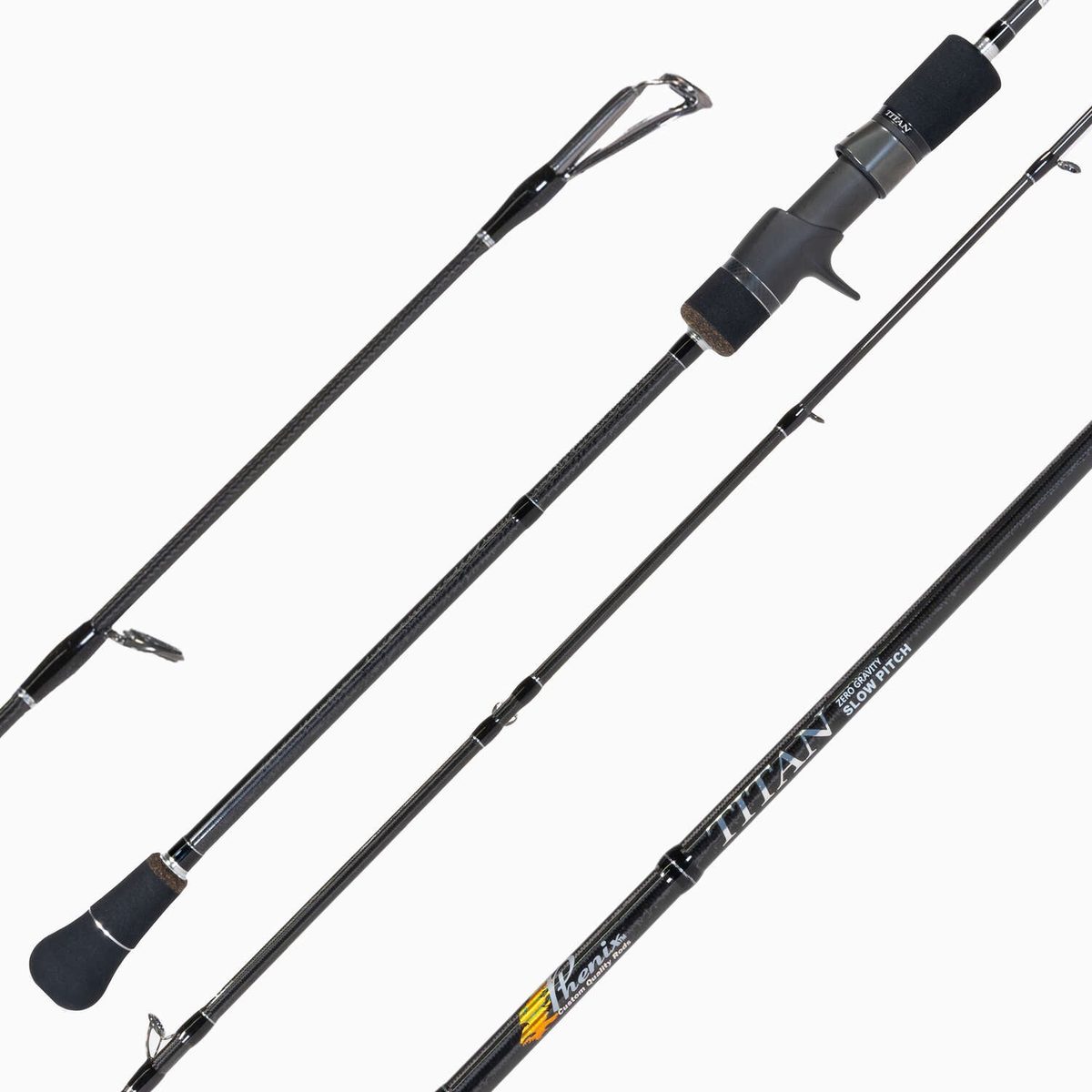
| Model | Length | Power | Jig weight | PE line |
|---|---|---|---|---|
| TJX-C 63UL | 6’3″ | Ultra Light | 20–60 g | PE 0.6–2.5 |
| TJX-C 63ML | 6’3″ | Medium Light | 100–250 g | PE 1.0–2.5 |
| TJX-C 63MH | 6’3″ | Medium Heavy | 150–350 g | PE 1.5–4.0 |
| TJX-C 63H | 6’3″ | Heavy | 200–480 g | PE 3.0–6.0 |
| TJX-C 68L | 6’8″ | Light | 60–180 g | PE 0.5–2.0 |
| TJX-C 68ML | 6’8″ | Medium Light | 100–250 g | PE 1.0–2.5 |
| TJX-C 68MH | 6’8″ | Medium Heavy | 150–350 g | PE 1.5–4.0 |
| TJX-C 68H | 6’8″ | Heavy | 200–480 g | PE 3.0–6.0 |
Price: $344.99–$399.99 depending on model (Phenix). All are casting (C) models.
Construction
- Blank: Toray T40 carbon fiber with a Multi Helix scrim and Phenix’s own Nanlite resins. The helix scrim reinforces the blank against twisting and crushing, and the resin system is meant to add strength without extra weight.
- Guides: Fuji K-series with SiC rings. The K-series frame shape helps shed braid tangles, which matters when you’re dropping and lifting thin PE all day.
- Handle: custom EVA
Why it matters for slow pitch: The rod’s recoil does the work. A blank that doesn’t twist loads and unloads the same way every time, so the jig moves as you intend. At the heavy end, it also keeps its shape when a big fish buries the rod.
6’3″ or 6’8″?
Phenix makes the same powers in two lengths, which lets you tune the rod to your boat and style:
6’3″ (the TJX-C 63 series)
– More leverage when fighting fish
– Easier to handle on a smaller center console or a crowded deck
– Shorter, quicker jig strokes
– The only length with the Ultra Light (20–60 g) option
6’8″ (the TJX-C 68 series)
– Longer, smoother lift on each stroke, which many slow pitch anglers prefer for a pronounced flutter
– Keeps line clear of the hull on a drift
– The only length with the Light (60–180 g) option
Most slow pitch rods fall between 6’3″ and 6’9″. Phenix gives you both ends of that range.
Choosing a power for Florida
| Your fishing | Phenix pick |
|---|---|
| Shallow reefs, light jigs, vermilion and mangrove snapper | 68L (60–180 g) or 63UL for micro jigs |
| Typical grouper and snapper ledges, 150–250 ft | ML (100–250 g) |
| Deeper ledges, 200–400 ft, moderate current | MH (150–350 g) |
| Deep grounds, strong Gulf Stream current, amberjack | H (200–480 g, PE 3–6) |
Tip: Choose power by the jig weights you’ll fish most, not the heaviest you might ever use. A rod working near the middle of its range gives the best slow pitch action.
Pairing a Titan
- Reels: a compact conventional with smooth drag. See Accurate Valiant SPJ, Shimano Ocea Jigger or Daiwa Saltiga 300.
- Line: match the PE rating on the rod. PE 1.5–2.5 (about 30–40 lb) suits the ML and MH, and PE 3–6 suits the H.
- Jigs: Shimano for everyday use, or Deepliner and Seafloor Control for specialized actions.
Care
- Rinse guides and reel seat after every trip.
- Check the SiC rings for cracks, because a cracked ring will cut braid.
- Use a rod sock and don’t let rods bang together in the holder on a rough ride home.
How to work a Titan: the slow pitch stroke
Slow pitch works best when the rod does the lifting. With a Titan:
- Drop and engage. Free-spool to the bottom, engage the reel, and take up slack with one or two turns.
- Lift and turn together. Raise the rod tip a short distance while turning the handle a set amount (a quarter, half or full turn). The rod loads with the jig’s weight.
- Let the rod recoil. Stop turning and let the blank spring back. The recoil throws the jig up, then it flutters and glides down on a slack line.
- Watch the fall. Most bites come as the jig falls. If the line stops, goes slack early or ticks, reel down and lift into the fish.
- Change the rhythm. Mix short and long strokes, and change how far you turn the handle, until the fish tell you what they want.
Why the Titan’s range helps: the rod has to load properly with your jig to recoil well. Fishing a 300 g jig on the MH (150–350 g) gives a strong, smooth recoil, while the same jig on the ML (100–250 g) would overload it. Matching the power to the jig is what makes the technique work.
Line and leader setup
- Main line: thin PE braid within the rod’s rating, such as PE 2 on an MH or PE 3–4 on an H. Thinner line has less drag in the current and keeps the jig more vertical.
- Leader: 3–5 m (10–16 ft) of fluorocarbon, heavier around wrecks and sharp structure.
- Knot: a slim braid-to-fluoro knot (such as an FG knot) that passes smoothly through the Fuji K-series guides.
Caring for a slow pitch rod
- Rinse after every trip. Rinse the whole rod gently with fresh water, paying attention to the guides and reel seat, and let it dry before storing.
- Check the guides. Run a cotton bud around each ring. If it snags, the insert is chipped and will damage thin PE line.
- Store it upright or in a rod sock. Slow pitch blanks are thin and light, so keep them away from heavy gear in the rod locker.
- Don’t high-stick. When a fish is near the boat, keep the rod angle low. Lifting the tip past vertical under load is the most common way slow pitch rods break.
Pros and cons
Pros
- Eight models from 20 g to 480 g, one of the widest slow pitch ranges from a US brand
- Two lengths (6’3″ and 6’8″) in the main powers
- Toray T40 carbon with a Multi Helix scrim and Fuji K-series SiC guides
- A heavy model (to 480 g, PE 3–6) for deep, strong-current Florida days
- Priced below most Japanese premium slow pitch rods
Cons
- Casting (conventional) models only in the Titan slow pitch range
- $344.99–$399.99 is more than entry-level rods like the Temple Reef Elevate ($249)
- Phenix doesn’t publish rod weights or maximum drag in the Titan table
Phenix vs. other slow pitch rods
| Rod | Lengths | Jig range | Price |
|---|---|---|---|
| Phenix Titan TJX-C | 6’3″, 6’8″ | 20–480 g | $344.99–$399.99 |
| Temple Reef Levitate X | 6’8″ | 50–500 g | $599.99 |
| Shimano Game Type Slow J | 6’6″ | to 330–500 g | $499.99 |
| Shimano Grappler Type Slow J | 6’8″ | to 260–330 g | $289.99 |
Where to buy Phenix slow pitch rods
Manufacturer
– Phenix Rods & Accessories, Irving, TX 75061 · 877-269-8490 · phenixrods.com
Florida
– Johnny Jigs, Pompano Beach: Phenix rod collection · 954-889-4915 · johnnyjigs.com
Other US retailers
– Fisherman’s Warehouse: Titan Slow Jigging “Slow Pitch” casting rods · fishermanswarehouse.com
– Tackle Express: Titan slow jigging rods · tackleexpress.com
– Melton Tackle: meltontackle.com
– Angler’s Choice Tackle: anglerschoicetackle.com
Verdict
Phenix’s Titan Slow Jigging series gives American anglers a deep, well-organized slow pitch range at a mid-level price. Toray T40 construction with a Multi Helix scrim, Fuji K-series SiC guides, and a choice of 6’3″ or 6’8″ in most powers let you match the rod to your boat and water. For South Florida, the MH (150–350 g) covers most ledges, and the H (200–480 g) handles deep water and current that lighter rods can’t.
Deep-Drop.com rating: Range 5/5 · Build quality 4.5/5 · Value 4.5/5 · US availability 4.5/5
FAQ
Where is Phenix Rods based?
Irving, Texas.
How much does a Phenix Titan slow pitch rod cost?
$344.99–$399.99 depending on model.
What’s the heaviest Phenix Titan slow pitch rod?
The TJX-C 63H and 68H, rated for 200–480 g jigs and PE 3.0–6.0.
Should I choose 6’3″ or 6’8″?
6’3″ gives more leverage and is easier on small boats. 6’8″ gives a longer, smoother lift and keeps line off the hull.
Specifications and prices were checked against phenixrods.com and US retailer listings on September 25, 2026.