
Choosing Slow Pitch Rods Step By Step
Learning how to choose a slow pitch jigging rod starts with the jigs already in your box, not the rod rack. A slow pitch rod does the work on the lift: the blank loads on the sweep and springs back, throwing the jig upward so your hand barely moves. Match the rod to the weights you fish most and the depth you fish them in, and every other decision gets simpler.
The mistake we see most is buying by price or brand first. Our view: a rod rated to 500 grams will not make a 150-gram jig fish better, and a rod rated to 150 grams will not lift a 300-gram jig — it bends and stays bent.
What a Slow Pitch Rod Actually Does
A slow pitch rod is short and parabolic. Parabolic describes how the blank bends. Our view: rather than loading only in the top third, it bends deep into the mid and lower blank, stores that load on the sweep and releases it as the jig is thrown upward.
Length is the other half of the design. Our slow pitch rods directory puts these rods at roughly six to six and a half feet, and a short rod is easier to work from a drifting boat.
How to Choose a Slow Pitch Jigging Rod, Step by Step
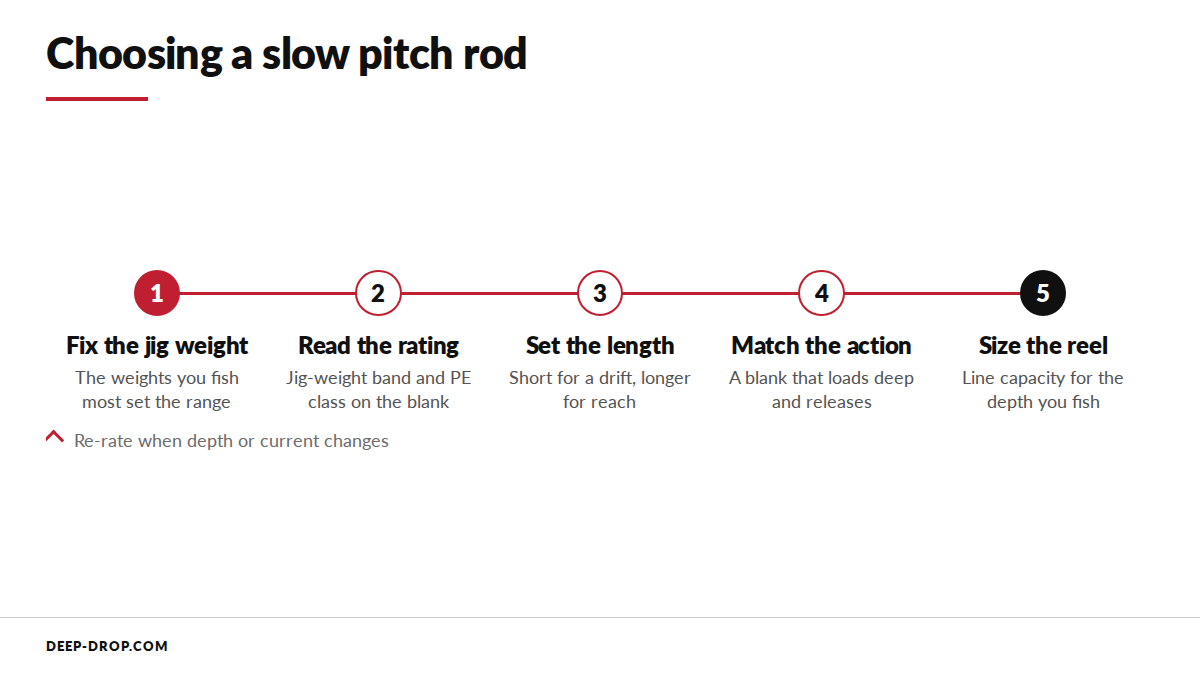
Start With the Jigs You Fish Most
Write down the three jig weights you reach for most, in grams. Most South Florida slow pitch happens with 200 to 400 gram jigs, and that is the band to build the rod around. If your box is still growing, start with a starter set of slow pitch jigs before you commit to a heavy blank.
Read the Jig-Weight Rating on the Blank
Slow pitch rods are rated by jig weight, and that figure is the one to shop on. Shimano lists the Game Type Slow J in three powers on a 6'6" blank: Medium to 330 grams, Medium-Heavy to 400 grams and Heavy to 500 grams. Phenix rates the Titan's heaviest power to 200 to 480 grams.
Warning
Our view: a rod fished above its stated jig rating is loaded past the point the blank was designed for. Buy the power that covers the jigs you fish most, not the heaviest jig in the box — the top of the range is a ceiling.
Pick the Length for Your Boat and Your Drift
Daiwa's Saltiga Slow Pitch is a 6'1" one-piece, Shimano's Game Type Slow J is 6'6", and Phenix builds the Titan in 6'3" and 6'8". Short rods are easier to work from a drifting boat, so lean short if deck space is tight.
Choose the Action and the Blank
Blank material and construction decide how the rod feels and how quickly it recovers. Phenix builds the Titan on Toray T40 carbon with a Multi Helix scrim and Nanlite resin; Nomad uses 30-ton Japanese Toray carbon in a Helix construction; Shimano's spec sheet names Spiral X Core and Hi-Power X for the Game Type Slow J; Daiwa's Saltiga uses HVF NANOPLUS.
A moderate, parabolic action is the default here: Shimano lists the Game Type Slow J's action as moderate, and Phenix labels the Titan's action as slow pitch. Our view: a softer tip is easier for a new angler to control.
Check the Rod's Weight in Ounces
Rod weight is the specification nobody reads and every angler feels by hour four. Phenix lists the Titan at 16 ounces, worth comparing against anything else on the rack before you call a rod light. Our view: working a jig off the bottom all day is a forearm exercise.
Size the Reel to the Rod and the Depth
Deep Florida drops need more PE line than many Japanese spec sheets assume. Our slow pitch reels directory covers the compact conventionals built for this job.
- Rods built around PE 5 to 8 for 500 to 600 gram jigs: pair with 10000, 14000 or 20000 size reels, Temple Reef's recommendation.
- Deep drops: match line capacity to the depth you fish, and allow more PE than a Japanese spec sheet assumes.
Look at the Grip, Seat and Guides
Phenix fits the Titan with a Fuji graphite reel seat with a trigger and Fuji SiC K-frame guides, nine plus a tip. Daiwa's Saltiga ships with a split EVA grip and ten Fuji LRV guides on a 6'1" blank, and Nomad uses a Fuji GM reel seat and a split rear grip.
Which Rod for Which Fish and Depth
Daiwa's own rod-selection table, as reproduced in our Daiwa slow pitch review, pairs lighter work with lighter rods and big, stubborn fish with heavier power — a useful template even if you buy another brand.
- Light jigs on shallow ledges under 150 feet: Saltiga SAGSL61LB or SAGSL61MB.
- Typical Florida ledges, 150 to 300 feet, 180 to 330 gram jigs: Saltiga SAGSL61MHB or SAGSL61HB, or an Outrage ORS68HB.
- Deep ledges and current, 400 to 500 gram jigs: Saltiga SAGSL61XHB, or a Harrier HSP66XHB on a budget.
- Very deep water and 800 gram jigs: Saltiga SGSL61XXH or Power Slow SGP61XH.
- Big amberjack and grouper on slow pitch gear: Saltiga Power Slow.
Two things to take from that table. Our view: depth and jig weight move together, so the light rod you use on a 120-foot ledge is the wrong rod on a 500-foot drop with current. And the middle of the table is where a first rod usually belongs.
Named Slow Pitch Rods and Their Stated Specs
These specs come from manufacturer sheets and dealer listings, and our view is the ratings do not always line up the way price tags suggest.
Shimano's Game Type Slow J is listed at $499.99: a 6'6" moderate-action rod built with Spiral X Core and Hi-Power X carbon and rated to 500 grams in its heaviest power. Temple Reef's Levitate X Nabla is a 5'9" rod, with models rated to 300, 400, 500 and 600 grams and PE ratings of 5 to 6 or 5 to 8.
Daiwa's Saltiga Slow Pitch is a 6'1" one-piece on an HVF NANOPLUS blank, and one retailer listing carries a limited lifetime warranty. Our Daiwa review prices the series at $569.99, with jig ranges from up to 120 grams on the SAGSL61LB to 230 to 500 grams on the SAGSL61XHB. Retailers publish slightly different ratings for the new Saltiga.
Phenix's Titan slow pitch runs from $344.99 to $399.99, is built on Toray T40 carbon with Nanlite resin, and is rated to 200 to 480 grams; one retailer listing puts it at 16 ounces. Nomad Design's slow pitch conventional rod is priced at $289.99: a 6'8" one-piece rated 2 to 11 ounces and PE 3 to 6 on a 40 to 80 pound line rating, with Fuji Alconite K guides and a Fuji GM reel seat.
On the US-facing end, our view is that St. Croix's Mojo Jig, Penn's Carnage III slow pitch conventional, JYG Pro's Revolution Pro Series SPJ and the Johnny Jigs Pro Jigger PLUS are worth handling in a shop, so confirm the jig-weight label on the rod itself.
Line, Leader and the Braid Question
Our view: the PE number names the braid class the blank was built around rather than a breaking strength. Nomad's PE 3 to 6 rating sits on a 40 to 80 pound line rating. Match your braid to that class rather than to the heaviest line the reel will hold.
We'd pick solid braid for slow pitch: it is thinner for a given strength than hollow core and cuts the water on the fall. Our view: solid PE with a short fluorocarbon leader is simpler and cheaper for the depths most US anglers fish.
For braid to leader, we'd tie an FG knot or a PR knot — both pass through near-micro guides without a clatter. Our view: fluorocarbon earns its last few feet against rock and teeth.
Care, Warranty and What Fails
Rinse the rod after every trip, working around the reel seat and the guides.
- Rinse the rod in fresh water after every trip, especially the reel seat and the guides.
- Run a cotton swab around the inside of each guide ring to catch a crack or a rough spot.
- Check the tip top and the guide wraps for lifted finish or a loose foot.
- Store the rod in a sleeve rather than leaning it in a rod holder.
- Re-check the drag and the top few metres of line before the next trip.
Warranty coverage varies and is worth asking about at the counter. One retailer listing gives the Daiwa Saltiga Slow Pitch a limited lifetime warranty, while our Daiwa review notes a five-year warranty on the current model — coverage on paper is only as good as the dealer behind it.
On breakage, the failures worth inspecting for are the ones you can see — a cracked guide ring, a lifted wrap near the tip, a reel seat that has started to work loose.
Adding It Up
Put the sequence together and the rod picks itself. You know your working jig weight, the power band that covers it, the length your boat and drift allow, and the blank and furniture you are paying for. The last check is the honest one: if the rod you can afford is rated well above the jigs you own, buy the jigs first.
If you would rather see a matched outfit than build one from a spec sheet, browse the tackle shop — the rods, reels and jigs on those pages are the ones our own trips run.
Related Reading
- slow pitch rods directory
- starter set of slow pitch jigs
- slow pitch reels directory
Sources
Manufacturer and retailer specifications
- GAME TYPE SLOW J
- Titan – Slow Pitch
- PATRIOT DESIGN Dogtooth Pro
- Daiwa Saltiga Slow Pitch Jigging Rods | other | fishlinebay.com
- Slow Pitch Jigging Rods
- Phenix Titan Slow Jigging Casting Rods
From Deep-Drop.com
- Slow Pitch Rods Directory – Florida Deep Drop Fishing Custom Rigs & Jigs
- Shimano Slow Pitch Rods Review (2026): Game Type Slow J & Grappler Type Slow J – Florida Deep Drop Fishing Custom Rigs & Jigs
- Daiwa Slow Pitch Rods Review (2026): Saltiga Slow Pitch, Power Slow, Outrage and Harrier – Florida Deep Drop Fishing Custom Rigs & Jigs
- Slow Pitch Reels Directory – Florida Deep Drop Fishing Custom Rigs & Jigs