
Deep drop fishing is not one depth; it is a band. Where that band sits depends on the fish you are after, how much lead your reel can wind, and how far offshore you are willing to run. This guide answers how deep is deep drop fishing for the water most US anglers actually fish, and explains what genuinely changes as you go down: the sounder, the rig, the presentation and the rules.
Important
- Deep drop begins around 300 feet, and powered setups run to 1,500 feet and beyond.
- Our view: reel line capacity, not the fish, usually sets how deep a given setup can go.
- Gulf and South Atlantic rules require non-stainless circle hooks with natural bait — non-offset in Gulf state waters and in the South Atlantic north of 28° N.
- From 50 feet down, a released fish may need a descending device to get back down.
How Deep Is Deep Drop Fishing? The Short Answer
Deep drop fishing depths are a band, not a figure. Deep-Drop.com's own deep drop fishing resources describes deep drop rigs as setups for great depths, "usually between 300 to 1,000 feet or more," where swordfish, tilefish, snapper and grouper are found. The site's electric reel directory stretches that to 300–1,500-plus feet. Above it sits the heavy end: Kristal's complete systems are built for 1,000–2,000 foot drops.
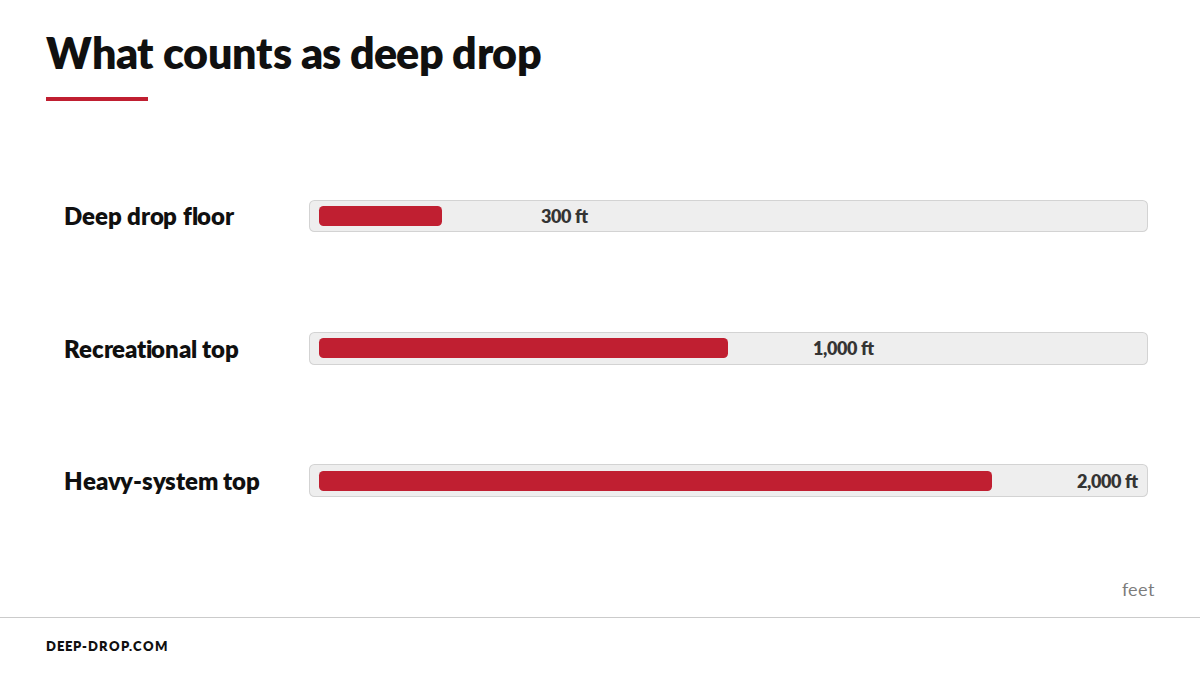
Our view: deep drop starts around 300 feet, where a hand reel and a light lead stop being practical, and runs to about 1,500 feet for most recreational boats.
Where Deep Water Starts: Shelf, Slope and Canyon
Depth is a feature of the seafloor long before it is a number on a screen, and the shapes that bottom makes decide where you stop.
The shelf, the slope and the canyon floor
The continental shelf is the broad apron of shallow bottom running out from the coast. At the shelf edge the bottom steepens and the continental slope begins, and the slope, not the flat, is what deep dropping is planned on. Where a submarine canyon cuts back into the slope, its floor carries deep water much closer to shore.
Reading the contour lines
Contours do the planning: lines bunched together mean a steep drop, widely spaced lines mean flat bottom. Mark the contour you mean to fish, note the drift direction, and work out where the boat will be when the rig touches down.
Reading Depth Before You Drop
Charts get you close, and the sounder tells you the truth.
Charts: Navionics, Blue Seas and contour resolution
Planning starts on the card your plotter runs — Navionics, Blue Seas, or whatever came loaded. What matters more than the brand is contour resolution: fine intervals show you where the drop sits, coarse ones only show that it exists.
Sounders: the low-frequency transducer and TVG
Run the low-frequency element for depth — it is the element that holds a bottom return in deep water — and keep the higher-frequency one for detail in the shallows. TVG, the gain that builds with range, keeps a faint deep echo visible instead of washing into speckle.
Matching Depth to Species
Gulf and South Atlantic targets
Deep-Drop.com's resources page puts swordfish, tilefish, snapper and grouper in the same 300-foot-and-deeper conversation, and its Kristal deep drop rods page lists tilefish and snowy grouper among the targets an entry deep drop system covers. Snowy grouper is the telling one: it is managed federally as part of the Gulf's Deep Water Grouper Complex, the clearest signal in the regulations that it belongs to the deep set.
Recreationally in federal Gulf waters, snowy grouper is open year-round with a four-fish bag limit and no minimum size, and the captain-and-crew bag limit on a charter or headboat is zero.
The southern-hemisphere names
Our view: hapuka, blue-eye trevalla and pink ling are the names the same deep-slope fishing carries in Australia and New Zealand — different water, the same idea of dropping heavy tackle onto a slope.
The Gear That Sets Your Depth
Gear does not make a deep drop possible, but it decides how deep you can repeat one. Three things set your ceiling:
- The contour you choose to fish.
- The published line capacity of the reel you own.
- The sinker weight the current demands.
Electric reels and published line capacity
An electric reel does the winding, hauling a weighted rig and a fish up from 300 to 1,500-plus feet, drop after drop. The electric reel directory splits the market into compact Japanese reels that run from a portable battery on a standard deep drop rod, Korean reels, and heavy American commercial reels built for hard-wired boat power.
| Reel | Published line capacity | Published notes |
|---|---|---|
| Shimano TLD 25 | 30 lb/600 yd · 40 lb/450 yd · 50 lb/350 yd | 22 lb max drag at full, 3.6:1 gear ratio |
| Jigging Master PE5 Monster Game | 400 m / 437 yd | lever drag, 35 lb effective, 60 lb max |
| Kristal KF001 system | 4,500 ft of 200 lb spectra | 600 lb pull, 320 ft/min retrieve |
Every figure above is a manufacturer's or retailer's published number — attributed to the Shimano TLD 25 listing, the Jigging Master PE5 listing and Kristal's specifications — not a measurement of ours. Our view: a 350-yard spool leaves little room on a 1,000-foot drop once scope and lost line are counted.
Bent-butt rods and line class
Deep drop rods are short, usually about 5 to 7 feet, built on glass or composite blanks and rated in 50, 80 and 130 lb classes, with bent butts or heavy roller or SiC guides. A bent butt makes rod-holder and harness fishing easier, and a swivel tip top lets the line run straight to the fish when the rod sits at an angle in the holder. Named models make it concrete: Shimano's Talavera Bluewater Deep Drop B is a one-piece 5-footer listed in a medium-heavy rated for 50–100 lb braid.
Braid, PE rating and the FG knot
Braid is the default because it barely stretches; Deep-Drop.com's resources page describes braided mainline as the choice for "enhanced strength and low stretch, essential for feeling bites from deep-dwelling fish." Jerry Brown's 65 lb solid braid is Spectra, sold in 300 to 2,500 yard spools.
Japanese and Australian rods and reels are often rated in PE — a braid size, not a pound test — and Deep-Drop.com's rod directory puts PE6 to PE10 at roughly the 80–130 lb range. The join between braid and leader is the FG knot: slim enough to run through the guides and strong in the heavy monofilament a deep rig needs.
Rigs and Weight for the Deep
The paternoster and multi-hook rigs
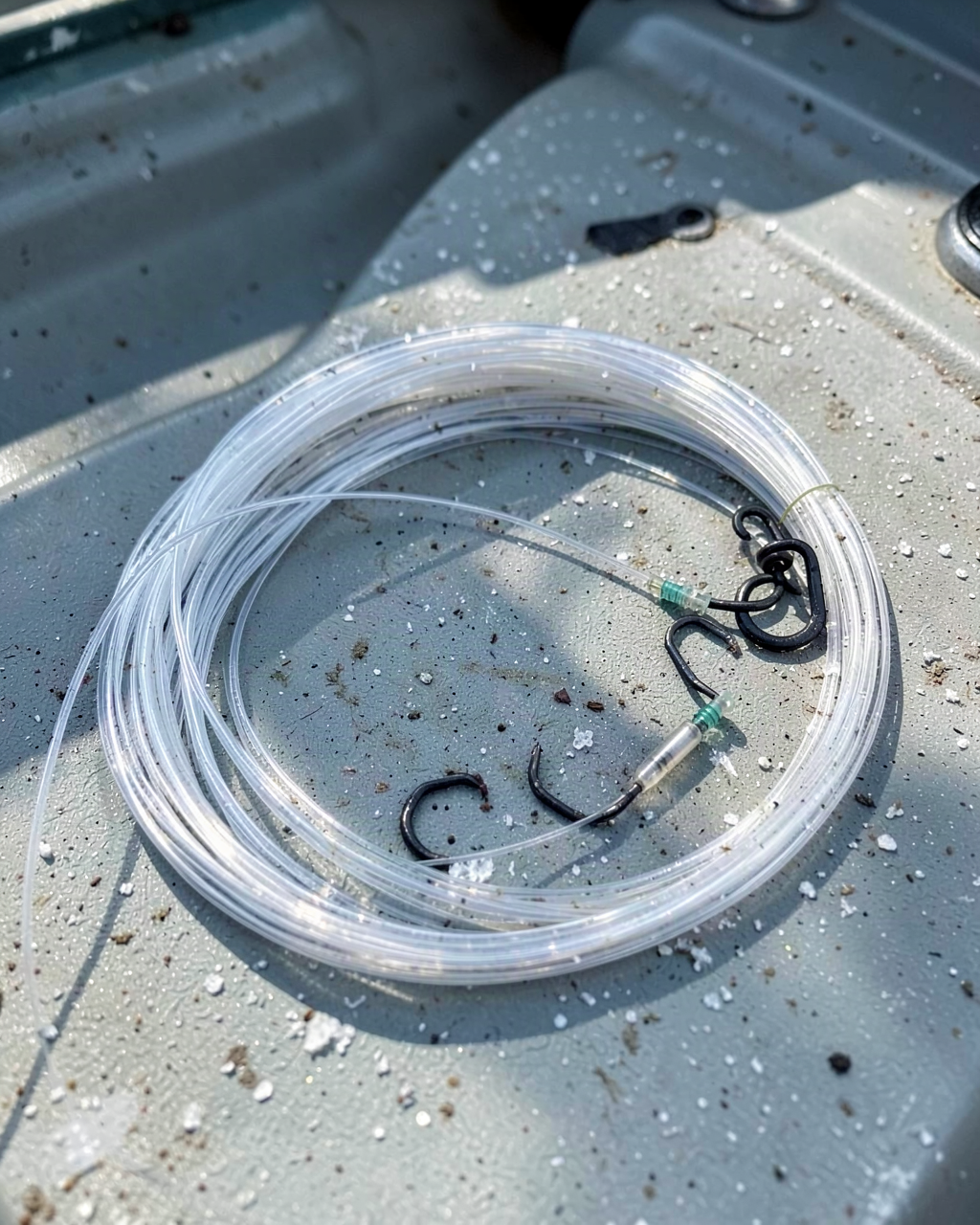
The workhorse deep rig is the paternoster: hooks on short droppers spaced above a heavy sinker. Deep-Drop.com's resources page describes the pattern as a rig with multiple hooks along the line, so a single drop can take several fish, with weighted sinkers attached to keep the line straight down and cut drift. Its how to build a deep drop rig guide walks the build step by step.
Sinkers and breakaway leads
Weight is the whole game. Too light and the rig sails off in the current; too heavy and you cannot read the bottom. Deep-Drop.com's rig notes describe sinkers "sometimes up to several pounds" for exactly this reason. Where the bottom is snaggy, a breakaway sinker earns its place: it sheds the lead when the rig hangs up, so you keep the hooks and the leader. Our view: on unfamiliar bottom, a breakaway lead costs less than a lost rig.
Circle hooks and lights
Circle hooks are close to standard for deep bottom fishing, and Return 'Em Right's circle-hook guide explains why: the shape lets the hook slide out of the fish's throat and catch in the corner of the jaw. The same guide notes that circle hooks work best with bait, are not designed for lures, and work especially well for snapper and grouper. Use non-offset, inline hooks: offset hooks bend the point to the side and are more likely to snag internal tissue.
Below a few hundred feet there is nothing to see by, which is why Deep-Drop.com's rig notes hang LED lights or glow sticks near the bait to draw fish out of the darkness.
What Your Bait's Depth Actually Is
The counter on the reel measures line out rather than depth, and deep dropping is where that difference starts to cost fish.
Fall time and presentation
A heavy lead falls fast and lands hard; a lighter one flutters down and fishes the whole column on the way. If the bites have been coming on the drop, that is information: something is meeting the bait on the fall, and the depth you thought you were fishing is not the depth that matters.
Current, scope and the real depth
Current pushes the line into a bow, so the bait trails up-current of the boat and sits higher than the counter suggests. The heavier the lead, the straighter the line and the closer the bait sits to the depth you planned.
Pressure, Barotrauma and Fish That Come Up
Depth does something to fish on the way up that shallow fishing never tests. Return 'Em Right notes that even fish pulled from 50-plus feet often suffer barotrauma — gases expand internally as the fish rises, leaving it bloated and unable to swim back down. Venting with a needle can help, but current guidance favours descending devices, which carry the fish back to depth on a weight and recompress the gases on the way.
Warning
Our view: a fish that cannot swim back down is unlikely to survive release. In the Gulf, reef-fish anglers must have a venting tool or descending device rigged and ready to use.
Rules That Change With Depth
Deep drop sits inside reef-fish regulation in the Gulf and the South Atlantic. In Gulf state waters, anglers fishing with natural bait must use non-stainless steel, non-offset circle hooks; in federal Gulf waters the hook must be non-stainless steel, and at least one dehooking device is required and must be used.
The South Atlantic tightens it further: north of 28° N latitude, near Cape Canaveral, non-offset, non-stainless circle hooks are required with natural bait in both state and federal waters. In both regions the hook must be non-stainless so it rusts away quickly if a line breaks, and the snowy grouper regulations are worth reading before you leave the dock.
Safety and Where the Cut-Off Sits
Deep dropping is done while drifting in open water, often a long run from the inlet, and the risks are about time and distance rather than depth. Before you drop:
- Check the weather window, not just the morning forecast.
- Know how your boat drifts and how long a retrieve from your target depth takes.
- Carry a plan for a power loss far offshore: charged batteries, spare fuses, a way to call for help.
- Set the day's cut-off depth before you leave the dock, while the decision is still easy.
Tip
Keep a spare pre-tied rig and a spare sinker clipped in a bucket on deck. A break-off at 900 feet then costs you a rig, not a day.
Our view: the cut-off is not a depth on the chart. It is the point where the run out, the drift and the weather no longer leave you a safe window to get back in. At 1,800 feet with a fish on, that window is smaller than it looks from the dock. Whatever depth you settle on, the rigs, rods, reels and terminal tackle to fish it are in the tackle shop.
Frequently Asked Questions
How deep is deep water fishing before it counts as a deep drop?
Around 300 feet is the practical floor, and most recreational deep dropping happens between 300 and 1,500 feet. The Deep-Drop.com resources page calls deep drop rigs setups for depths "usually between 300 to 1,000 feet or more," and the electric reel directory extends the range past 1,500 feet.
What is the 80/20 rule in fishing?
Our take: the 80/20 rule in fishing holds that most of the fish come from a small share of the water. Deep dropping makes it concrete — a tight contour on the slope beats a wide, flat drift, so the hours go into finding the right contour rather than covering more ground.
What is the best rig for grouper and snapper fishing?
Our view: a paternoster-style bottom rig with non-offset circle hooks and enough sinker to hold bottom is the one to start with. It fishes several hooks on one drop, and circle hooks are what Return 'Em Right points to for snapper and grouper.
How do I know how deep to fish?
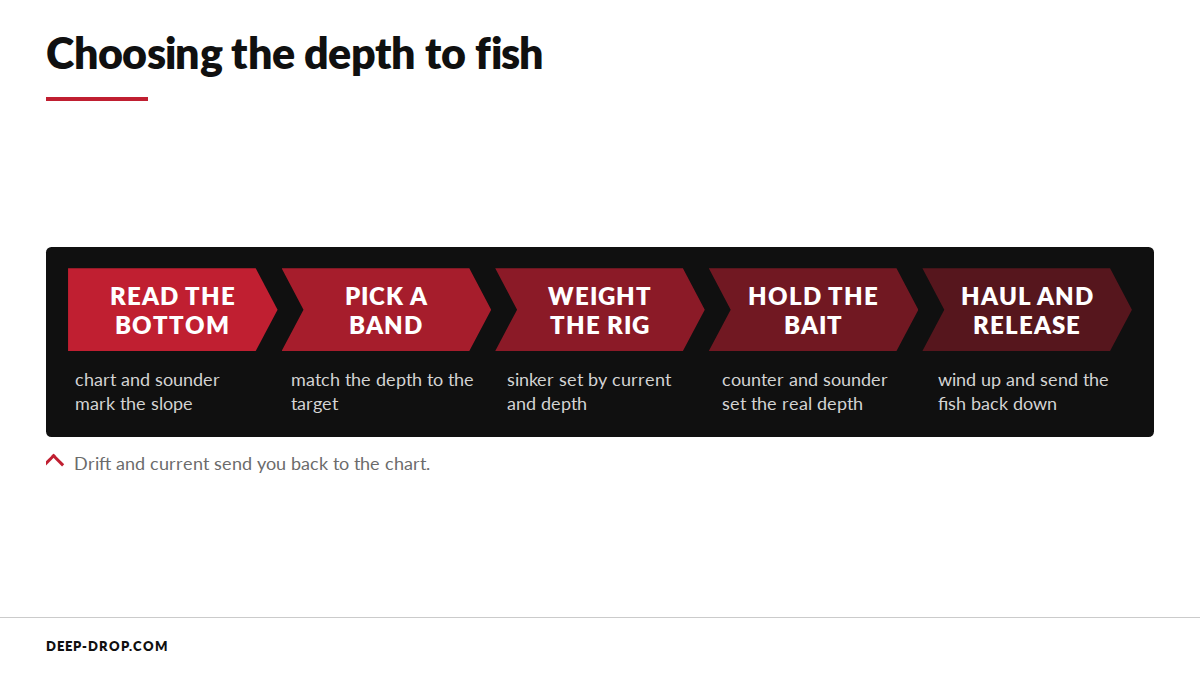
Our method: start on the chart, pick the contour that matches the species you want, confirm the bottom on the sounder, then let the current set the sinker weight. If the bites come on the fall, fish shallower; if they come on the bottom, stay put.
Sources
Research
Manufacturer and retailer specifications
From Deep-Drop.com
- Deep Drop Fishing Resources – Florida Deep Drop Fishing Custom Rigs & Jigs
- Каталог электрических катушек – Florida Deep Drop Fishing Custom Rigs & Jigs
- Kristal Deep Drop Rods & Systems Review (2026): KF001, KF003, KF004, C/KF Rods and Mounts – Florida Deep Drop Fishing Custom Rigs & Jigs
- Deep Drop Rods Directory – Florida Deep Drop Fishing Custom Rigs & Jigs